
For a while, the conversation around legal AI was mostly about speed.
Faster research.
Faster drafting.
Faster contract review.
Faster summaries.
That made sense. Legal work is document-heavy, deadline-heavy, and often repetitive. So when generative AI started helping lawyers move through large volumes of information faster, the first reaction was obvious: this could save time.
But the legal industry is now facing the harder question.
Reference: https://www.tlt.com/insights-and-events/insight/tlts-ai-brief-september-2026
Not can AI help produce legal work faster?
But who is responsible when that work is wrong?
That is where legal AI is entering a new phase.
Not the experimentation phase.
Not the excitement phase.
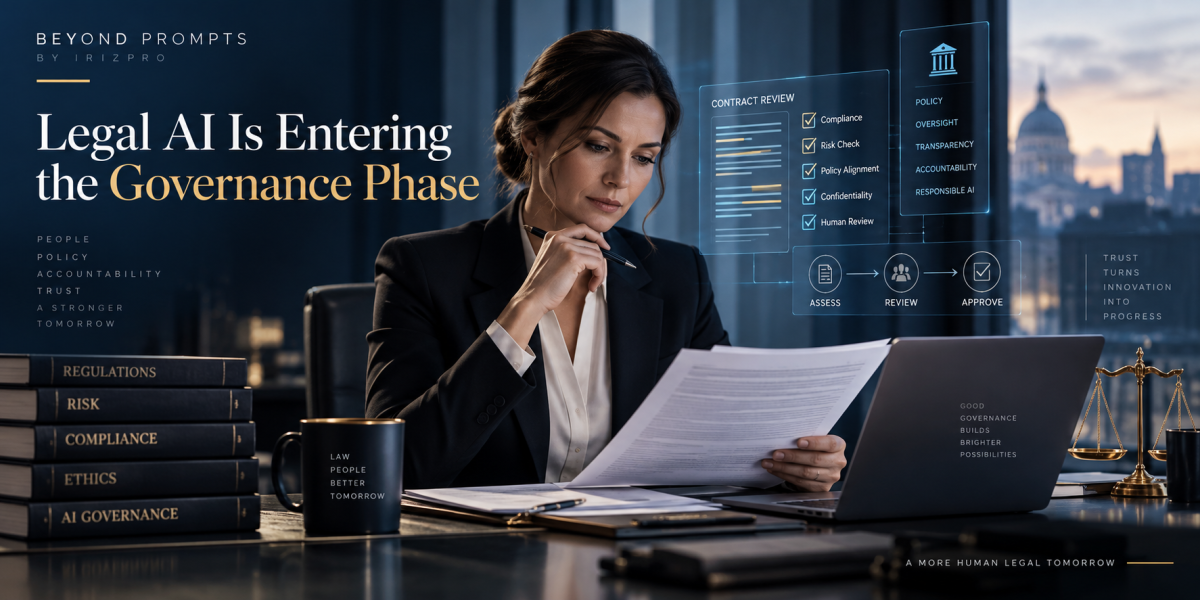
The governance phase.
Recent developments show why this shift matters. Google Cloud launched Gemini Enterprise for Legal in August 2026 as a purpose-built legal AI platform for law firms and legal teams, with launch customers including Cleary, Freshfields, Weil, and Williams & Connolly. At the same time, California lawmakers passed a bill governing lawyers’ use of generative AI, including disclosure requirements for court-submitted documents and restrictions around confidential information in certain AI systems.
Legal AI is no longer just about whether lawyers can use AI.
It is about how they use it, where they use it, and who remains accountable.
The Problem Is No Longer Just Output
A lawyer can ask AI to summarize a case file, review a clause, draft a note, compare two agreements, or prepare a first version of a memo.
That sounds useful.
But legal work is not ordinary writing. A small error can have consequences. A wrong citation can weaken an argument. A missed clause can change commercial risk. A careless upload can expose confidential client information. A poorly reviewed draft can create liability.
This is why legal AI cannot be treated like a simple productivity tool.
In most businesses, an AI mistake may create confusion.
In legal work, it can affect rights, contracts, trust, and professional responsibility.
That changes everything.
Where Legal AI Helps and Where Lawyers Must Decide
| Legal Work Area | Where AI Can Help | Where Human Judgment Is Needed |
|---|---|---|
| Contract review | Flag unusual clauses, compare versions, summarize obligations | Decide risk position, negotiation strategy, final wording |
| Legal research | Find relevant material, summarize case law, organize references | Verify authority, interpret relevance, apply it to client context |
| Drafting | Prepare first drafts, structure notes, improve readability | Final legal advice, accuracy, tone, accountability |
| Litigation support | Build timelines, organize evidence, identify gaps | Strategy, argument building, court submissions |
| Client communication | Draft status updates, summarize pending actions | Sensitive advice, legal position, relationship judgment |
AI can assist the work.
But it cannot own the professional judgment behind the work.
AI May Draft, But Someone Still Has to Own the Judgment
One of the biggest risks in legal AI is the false comfort of a good first draft.
AI-generated work can look polished. It can sound confident. It can organize information neatly. That makes it easy to trust too quickly.
But legal judgment is not just about clean language.
It requires context.
It requires interpretation.
It requires understanding the client’s position.
It requires knowing what not to say.
It requires deciding which risk matters most.
AI can support that work. It cannot carry professional accountability for it.
So the responsibility still sits with the lawyer, the firm, and the process around the tool.
That is the governance issue.
The Legal AI Risk Map
| Risk Area | What Can Go Wrong | Governance Needed |
|---|---|---|
| Confidentiality | Client data entered into an unapproved AI tool | Approved platforms and clear data-use rules |
| Accuracy | AI produces incorrect or incomplete legal output | Human verification and review standards |
| Citations | AI creates false or weak references | Source validation before use |
| Accountability | No one clearly owns the final output | Defined approval and responsibility process |
| Client trust | AI use feels hidden, careless, or uncontrolled | Transparency and communication rules |
| Security | Sensitive files move outside firm control | Access controls, permissions, and audit logs |
This is why legal AI governance must be practical. It cannot remain a policy document that nobody uses.
Confidentiality Is the Real Test
For law firms, the biggest question is not whether AI can draft a better clause.
The bigger question is:
Should this information be entered into this AI system at all?
Legal documents often contain privileged communication, commercial terms, dispute strategy, personal information, financial details, regulatory exposure, and sensitive client context.
Uploading that material into an unapproved tool is not a small operational choice. It can become a serious risk.
A Reuters legal industry analysis warned that prompts entered into AI tools may create risks around discovery, law enforcement access, or attorney-client privilege waiver, and argued that organizations need effective AI governance policies to manage those risks.
The governance question is not just:
Did the AI produce a useful answer?
The better question is:
Was the information used safely in the first place?
The First-Draft Review Checklist
| Before Using AI Output | Question to Ask |
|---|---|
| Source check | Are the citations, clauses, or references verified? |
| Context check | Does the output understand the client’s actual situation? |
| Risk check | Has the legal or commercial risk been reviewed? |
| Confidentiality check | Was any sensitive information used safely? |
| Tone check | Does the draft match the firm’s professional standard? |
| Approval check | Has the right lawyer reviewed and approved it? |
Many people say, “AI only creates the first draft. A human will review it.”
That sounds safe, but only if the review is real.
If a lawyer only lightly edits an AI draft, the risk remains.
If a junior team relies on AI output without checking sources, the risk remains.
If the firm has no review standard, the risk remains.
If nobody knows whether confidential data was used, the risk remains.
A human-in-the-loop process is not just a line in a policy document.
It has to be visible in the workflow.
What Law Firms Should Allow, Control, or Avoid
| AI Use Case | Suggested Approach |
|---|---|
| Summarizing public legal material | Allow with review |
| Drafting internal research notes | Allow with citation checks |
| Comparing contract versions | Allow with lawyer review |
| Drafting client updates | Control with human approval |
| Using AI for court filings | Control with strict verification |
| Using AI agents to take workflow actions | Control with permissions and audit logs |
| Uploading confidential client files to public AI tools | Avoid |
| Creating final legal advice without review | Avoid |
The firms that benefit most from AI will not be the ones that use it everywhere.
They will be the ones that know where AI belongs and where it does not.
That distinction matters.
Legal AI Will Change How Firms Work
This does not mean law firms should avoid AI.
In fact, the opposite may be true.
AI can be extremely useful for legal teams when used carefully. It can help organize documents, summarize long files, compare drafts, create timelines, identify unusual clauses, prepare internal notes, and reduce repetitive review work.
Google’s legal AI launch is a signal of this shift. The company describes Gemini Enterprise for Legal as an enterprise-grade, purpose-built agentic AI solution designed for complex legal requirements and workflows. Axios also reported that Google’s general counsel emphasized AI cannot replace human judgment in legal work.
That point matters because legal work does not end at output.
AI may be useful for preparing a first summary.
But not for final legal advice without review.
AI may help compare contract versions.
But not decide the client’s risk position.
AI may assist with research.
But not replace source verification.
AI may help draft a client update.
But not own the professional tone, judgment, or responsibility behind it.
From Experimentation to Governance
| Earlier Legal AI Phase | Governance Phase |
|---|---|
| “Can AI draft faster?” | “Who verifies the draft?” |
| “Can AI summarize documents?” | “What data was uploaded?” |
| “Can AI reduce research time?” | “Were sources checked?” |
| “Can teams use AI tools?” | “Which tools are approved?” |
| “Can AI improve productivity?” | “Who is accountable for the result?” |
This is the real shift.
Legal AI is not becoming less useful.
It is becoming more serious.
The Business Model Will Also Change
There is another uncomfortable question for law firms.
If AI helps complete some work faster, what happens to pricing?
Clients may begin asking why certain tasks still take the same time or cost the same. Routine research, document review, first drafts, due diligence summaries, and contract comparisons may become more efficient.
That could put pressure on traditional billing models.
But this does not mean legal value becomes cheaper.
It means the value shifts.
Clients may pay less for repetitive effort.
But they may value stronger judgment, faster turnaround, better risk clarity, better documentation, and more transparent processes.
In other words, AI may reduce the value of some manual work, but increase the importance of trusted advisory work.
The Real Opportunity Is Disciplined Adoption
Legal AI should not be sold as a shortcut.
It should be treated as an intelligent support layer inside a controlled professional workflow.
Good legal AI adoption will need:
| Governance Area | What Firms Need to Define |
|---|---|
| Tool approval | Which AI tools lawyers and staff can use |
| Data safety | What information can and cannot be uploaded |
| Human review | Who must review AI-generated work before use |
| Citation checks | How legal references and authorities are verified |
| Client communication | When and how AI use should be disclosed |
| Auditability | How AI-assisted work is tracked and approved |
| Training | How lawyers, associates, and support teams should use AI responsibly |
This may sound less exciting than “AI will transform law.”
But it is more realistic.
And in legal work, realistic matters.
Beyond Prompts Perspective
Legal AI is entering the governance phase because the legal industry cannot afford blind trust in automation.
The question is not whether AI can help lawyers. It can.
The real question is whether law firms can use AI without weakening confidentiality, judgment, accountability, and client trust.
AI may draft the first version.
But the final responsibility must remain human.
That is the line law firms cannot afford to blur.
Final Thought
The future of legal AI will not be about replacing lawyers with machines.
It will be about giving lawyers better tools, while making responsibility clearer than ever.
Because in law, speed is valuable.
But trust is everything.