
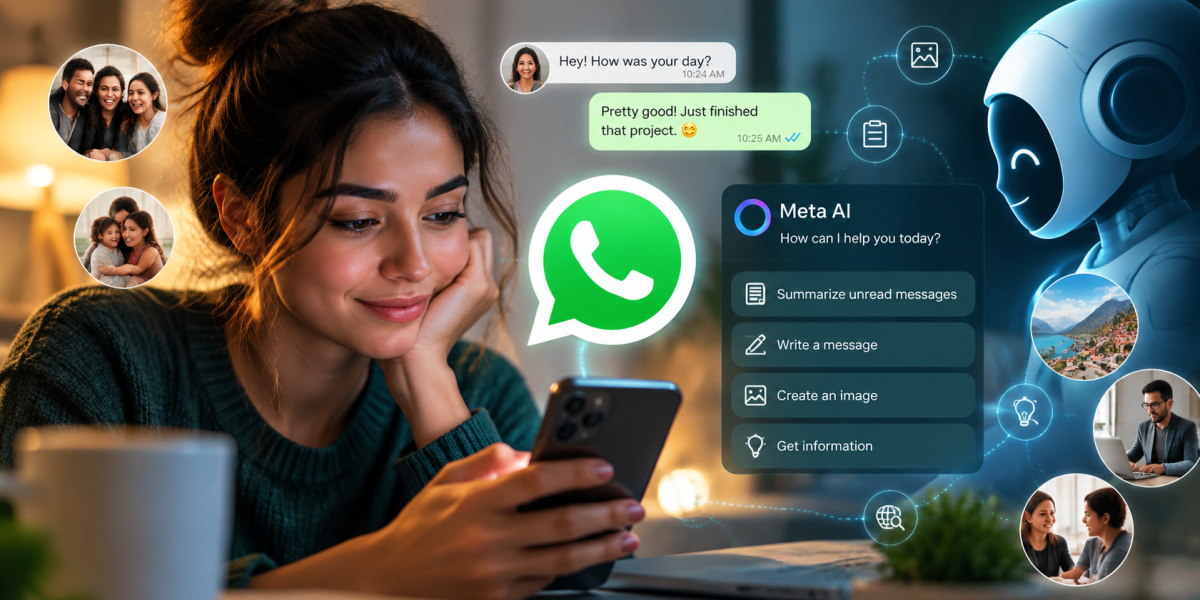
WhatsApp always represented a private space where humans talked to humans. But the rise of the WhatsApp AI chatbot is changing that experience. Messaging platforms are moving beyond simple conversations and becoming intelligent interfaces where users can ask questions, automate tasks, create content, and interact with AI assistants.
This shift raises a deeper question:
When a chat window can contain humans, businesses, and artificial intelligence at the same time, what happens to the human experience behind the conversation?
The future of messaging may not simply be about faster communication. It may be about redefining what communication means.
From Messaging App to AI Interface
Technology often evolves from tools into environments.
- Search engines became information platforms.
- Smartphones became personal computing devices.
- Social networks became commerce and media ecosystems.
- Messaging apps are now becoming AI-powered assistants.
The traditional WhatsApp experience:
| Before AI | With AI Integration |
|---|---|
| Send messages | Ask questions |
| Share photos | Create and edit images |
| Call contacts | Access digital assistants |
| Search manually | Receive conversational answers |
| Customer support by humans | AI-assisted support |
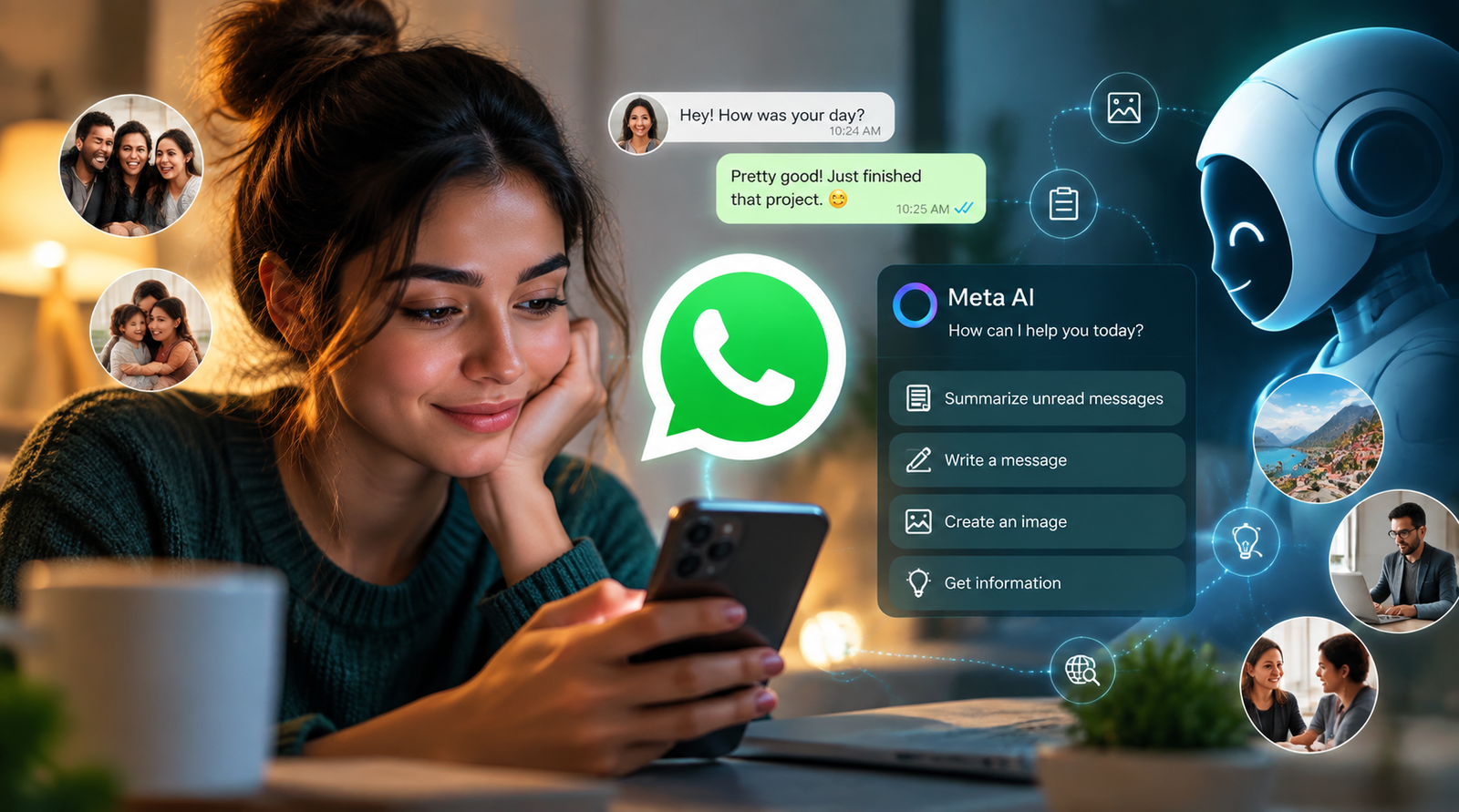
Meta has expanded AI features inside WhatsApp, including creative tools, AI-generated backgrounds, and assistance features designed to help users interact more naturally inside chats.
The chat box is becoming more than a communication tool.
It is becoming an interface for getting things done.
The Latest WhatsApp AI Developments
AI adoption inside messaging is accelerating. Recent updates show how quickly the role of chat is changing.
| Development | What It Means |
|---|---|
| Meta AI inside WhatsApp | Users can interact with an AI assistant directly in conversations |
| AI image creation tools | People can generate and edit visuals without leaving chats |
| AI message summaries | Users can catch up on unread conversations faster |
| Business AI tools | Companies can automate parts of customer communication |
Meta introduced AI-powered message summaries for WhatsApp, designed to help users catch up on unread messages while maintaining controls around privacy through its Private Processing approach.
Meta has also expanded AI personalization efforts, including features that allow Meta AI to remember certain details users choose to share in one-to-one chats in supported markets.
The Human Question: Are We Outsourcing Conversation?
The biggest change may not be technical.
It may be emotional.
Communication is not only about transferring information. Humans communicate to:
- Feel understood
- Build relationships
- Express personality
- Share experiences
- Create trust
AI can write a message.
But it does not have a childhood memory with your friend. It does not share your family history. It does not experience emotions.
This creates a new challenge:
If AI helps us communicate more efficiently, will we also become less personally involved?
The AI Communication Balance
The future is unlikely to be humans versus machines.
It is more likely to be humans working alongside AI.
| Task | Human Strength | AI Strength |
|---|---|---|
| Writing a quick reply | Personal tone | Speed |
| Researching information | Judgment | Processing large data |
| Supporting a friend | Empathy | Availability |
| Customer service | Complex situations | Repetitive questions |
| Creativity | Original ideas | Generating variations |
The skill of the future may be knowing when not to use AI.
A business complaint may need empathy.
A family conversation may need authenticity.
A simple scheduling message may benefit from automation.
Privacy Becomes the New Trust Test
As AI enters private messaging spaces, privacy becomes a central issue.
People use WhatsApp for conversations involving:
- Personal information
- Work discussions
- Financial matters
- Family communication
The challenge for AI-powered messaging platforms is balancing convenience with user trust.
Users will increasingly ask:
Who can access my conversations?
What does AI remember?
When is automation helpful, and when is it too intrusive?
Meta has highlighted privacy-focused approaches such as Private Processing for certain AI features, stating that some AI processing methods are designed so WhatsApp and Meta cannot access the private content involved.
Businesses Are Entering the AI Chat Era
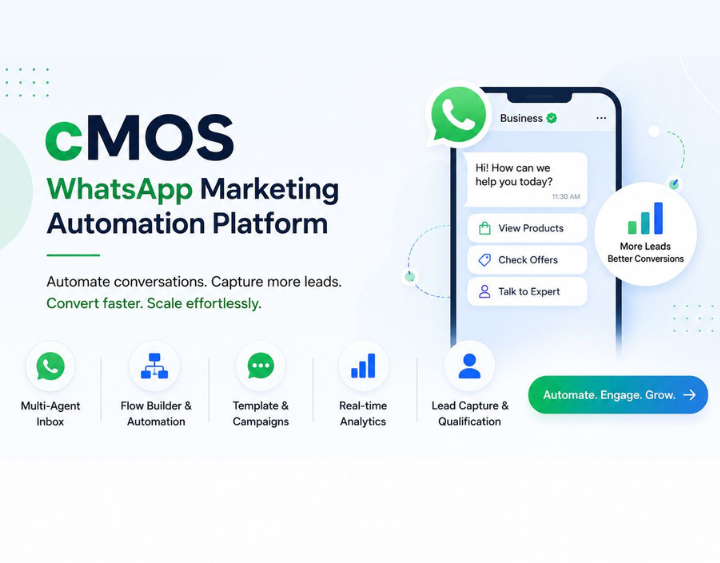
For businesses, the WhatsApp AI chatbot is becoming an important customer engagement tool. Companies can use AI-powered conversations to answer frequently asked questions, provide product information, support customers, and route complex issues to human representatives.
Business Use Case How WhatsApp AI Chatbot Helps Customer support Provides instant answers 24/7 Sales inquiries Shares product details and recommendations Appointment booking Automates scheduling Lead generation Captures customer information Follow-ups Sends timely reminders
Interactive Question: What Type of Chat User Are You?
Which one describes you?
| User Type | Behaviour |
|---|---|
| The Automator | Uses AI to save time and write faster |
| The Explorer | Uses AI to learn and discover ideas |
| The Traditionalist | Prefers human conversations without AI |
| The Hybrid User | Uses AI when helpful but keeps human moments personal |
The future of messaging will depend not only on technology companies.
It will depend on how people choose to use these tools.
The Future of WhatsApp: More Intelligent, More Personal, More Complex
WhatsApp is moving from being a place where conversations happen to becoming a place where actions happen.
You may ask AI to:
- Explain something
- Plan a trip
- Create content
- Help a business customer
- Organize information
But the most valuable conversations will likely remain human.
AI can make communication faster.
Only humans can make it meaningful.
Final Thought
The rise of AI inside WhatsApp does not mean humans disappear from conversations.
It means the definition of conversation is changing.
The future question is not:
“Will AI replace human communication?”
It is:
“How do we use AI without losing the human reason we communicate?”
Because the technology behind the chat may become smarter.
But the person behind the chat will always be the reason it matters.
FAQ
What is a WhatsApp AI chatbot?
A WhatsApp AI chatbot is an artificial intelligence assistant that operates within WhatsApp conversations to answer questions, automate tasks, and help users communicate more efficiently.
How does a WhatsApp AI chatbot work?
A WhatsApp AI chatbot uses artificial intelligence and natural language processing to understand user messages and provide relevant responses.
Can WhatsApp AI chatbots replace human customer service?
WhatsApp AI chatbots can handle repetitive questions and routine requests, but human agents remain important for complex, emotional, or sensitive conversations.
Are WhatsApp AI chatbots safe to use?
Safety depends on how the chatbot is designed, what data it accesses, and what privacy controls are available to users.