
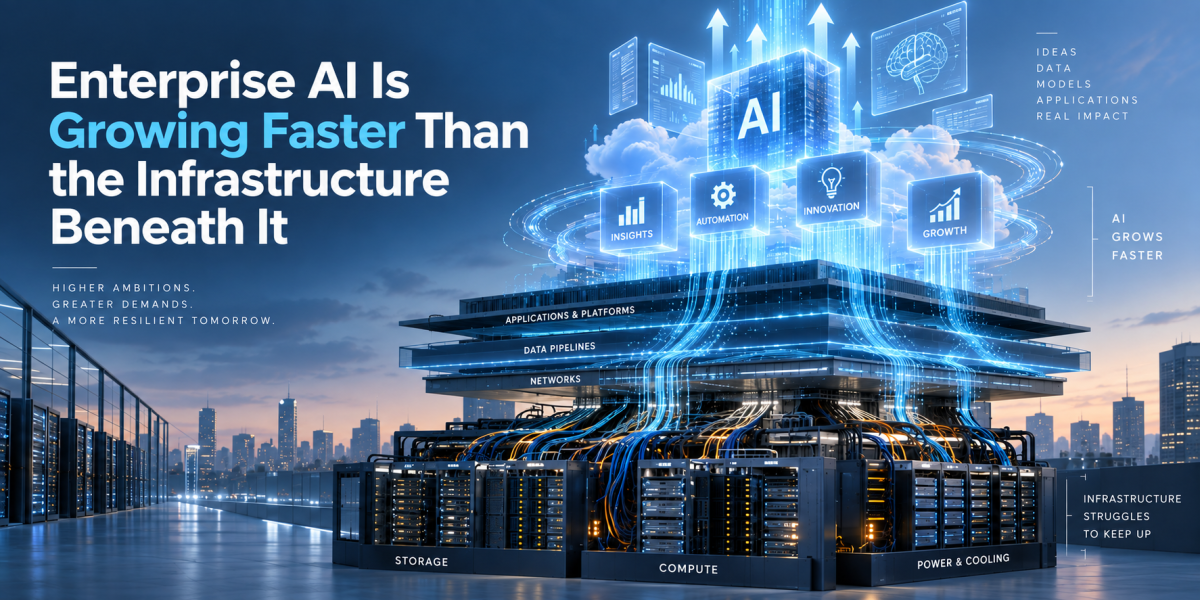
Everyone’s betting big on AI. Almost nobody’s ready for what it actually costs to store, power, and maintain.
That’s the uncomfortable headline buried in Seagate’s 2026 Data Infrastructure Readiness Report, conducted by Recon Analytics, which surveyed 2,712 enterprise technology decision-makers across the US, China, India, UK, Germany, France, and Japan. The findings paint a picture that’s becoming familiar across the industry: enterprise ambition is sprinting ahead of enterprise infrastructure, and the gap between the two is widening, not closing.
This isn’t a story about AI failing to deliver. It’s a story about what happens when demand for AI outpaces the boring, unglamorous groundwork — storage, energy, data governance — that AI actually runs on.
Reference: https://www.techedt.com/seagate-survey-finds-ai-storage-demand-is-rising-faster-than-enterprise-readiness
The Numbers Don’t Lie
Nearly every enterprise leader surveyed sees AI stretching their storage needs to the breaking point. 99% expect AI to increase storage requirements over the next three years, and 32% are bracing for capacity growth beyond 50%. That’s not incremental planning. That’s a data explosion on the horizon, and most organisations know it’s coming.
Yet only 38% of respondents consider themselves fully prepared to manage those incoming demands.
Read that gap again. Two-thirds of enterprise decision-makers can see the wave building and still don’t feel ready to meet it. That’s not a minor planning oversight — it’s a structural readiness problem sitting at the centre of enterprise AI strategy right now, and it’s one that’s easy to miss when the conversation stays fixated on models, chatbots, and AI use cases instead of the infrastructure underneath them.
Returns Are Real — So Is the Friction
To be clear, this isn’t AI skepticism. Companies are genuinely getting value out of their investments. 86% of respondents report moderate or significant returns from their AI investments, with 33% calling those returns significant and measurable. AI is working. Enterprises aren’t wasting money chasing hype for hype’s sake.
The problem isn’t whether AI delivers ROI. It’s whether the plumbing behind it can hold up as usage scales.
Data quality and readiness top the list of deployment challenges at 53%, followed closely by storage infrastructure at 43%. Compute and energy trail but aren’t far behind — 27% cite compute availability as a barrier, and 24% point to energy constraints. In other words, this isn’t a single bottleneck enterprises can solve with one big infrastructure purchase. It’s four pressure points tightening simultaneously: dirty or unstructured data, insufficient storage capacity, compute limitations, and power constraints. Solve one and the other three are still waiting.
This is where a lot of enterprise AI strategy quietly breaks down. Leadership teams greenlight AI pilots, see early wins, and scale adoption — without first asking whether the underlying data infrastructure can support that scale without buckling. Seagate’s numbers suggest a lot of organisations are finding out the hard way that storage and compute planning can’t be an afterthought once AI moves from pilot to production.
Money Is Moving – Just Not Evenly
Enterprises aren’t ignoring the infrastructure problem. Investment is happening, and at real scale. 76% of respondents rank data centre investment among their organisation’s top three infrastructure priorities, and 20% call it their single highest priority. That’s a serious commitment of capital toward fixing the gap.
But investment alone isn’t strategy, and money thrown at infrastructure doesn’t automatically translate into readiness. AI strategy maturity was the most commonly cited barrier to preparedness, at 16%, with budget and resource constraints and data management and governance tied close behind at 14% each. Enterprises can build bigger data centres and still be unprepared if their AI strategy, governance frameworks, and data management practices haven’t matured at the same pace as their infrastructure spend.
That distinction matters. Notably, 98% of respondents agreed that AI is turning storage into strategic business infrastructure — not a cost centre to be minimised, but a core asset tied directly to how much value an organisation can extract from its data over time.
Seagate’s Melyssa Banda, senior vice president of Edge Storage Business at Seagate Technology, framed this shift as a philosophy change rather than just a spending spree. The goal isn’t simply to buy more storage — it’s to build infrastructure that’s efficient, durable, and connected to long-term data value, rather than reactive purchases made to plug immediate capacity gaps as they appear.
Energy Is the Quiet Constraint Reshaping Plans
Here’s the part of this story that doesn’t get nearly enough attention in the broader AI infrastructure conversation: sustainability isn’t a side issue anymore. It’s actively rewriting enterprise AI roadmaps in real time.
77% of organisations have already delayed or restructured AI infrastructure expansion because of energy and sustainability concerns, with 36% making significant changes to their planned investments as a direct result. This isn’t a hypothetical future constraint — it’s already shaping decisions being made today, in boardrooms, about how fast and how far AI infrastructure can scale.
When you break down the specific environmental concerns driving these decisions, AI-related energy consumption tops the list at 52%, with carbon emissions from that energy consumption close behind at 51%. Enterprises are increasingly aware that AI workloads are power-hungry, and that power has both a cost line and a sustainability commitment attached to it — two pressures that don’t always pull in the same direction.
Equipment lifecycle thinking is shifting alongside this. 97% of respondents agree that extending infrastructure lifecycles meaningfully improves sustainability outcomes, and 94% expect their storage operations to become more sustainable over the next five years. That suggests a broader move away from rip-and-replace infrastructure cycles toward longer-term, more deliberate hardware strategies — squeezing more value and more years out of existing systems rather than constantly refreshing them.
What This Means for Enterprise AI Strategy Going Forward
Put all of this together and a clear pattern emerges. AI adoption isn’t the risk anymore — the infrastructure gap underneath it is. Enterprises have proven AI pays off. What they haven’t fully solved is the unglamorous foundation that makes sustained AI performance possible: clean, well-governed data; storage capacity that scales with demand instead of lagging behind it; energy strategies that don’t force last-minute compromises; and AI governance maturity that keeps pace with adoption speed.
The winners over the next few years in enterprise AI won’t necessarily be the companies that adopted AI fastest, or the ones who ran the flashiest pilots. They’ll be the organisations that treated infrastructure readiness as a prerequisite rather than an afterthought — the ones who built the storage, energy, and governance foundation before the ceiling caved in, instead of scrambling to reinforce it after growth had already outpaced capacity.
Seagate’s report is, in effect, an early warning. Enterprise AI demand isn’t slowing down — 99% of decision-makers expect storage needs to keep climbing over the next three years. The organisations that close the readiness gap now, while the wave is still building, will be the ones positioned to actually capture the value AI promises, rather than getting caught flat-footed by it.