
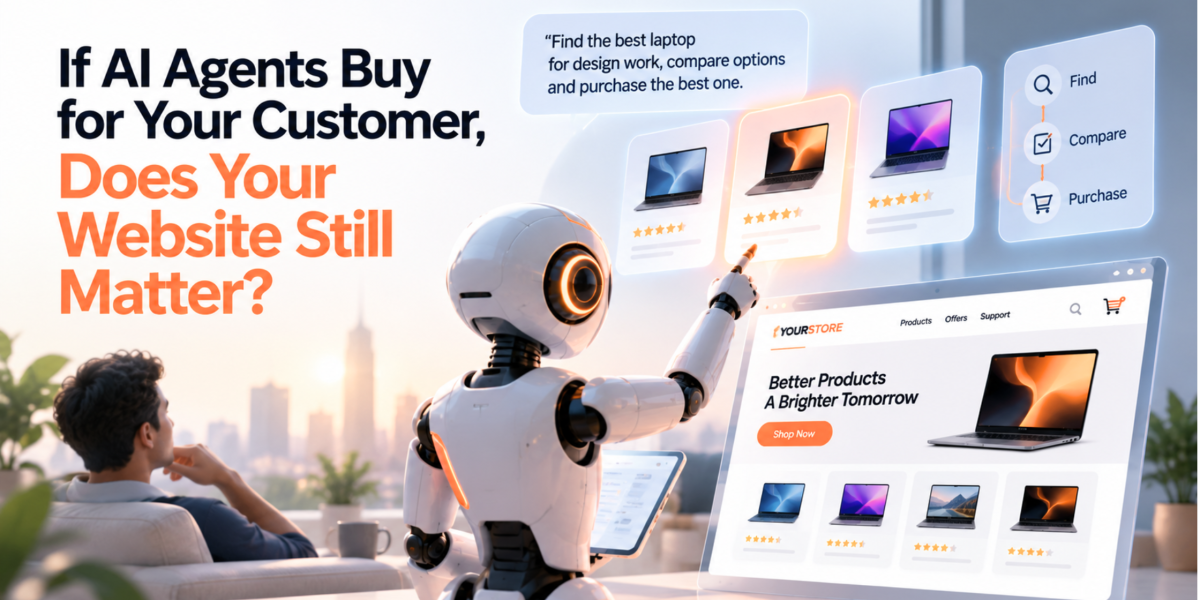
Imagine you need a new laptop.
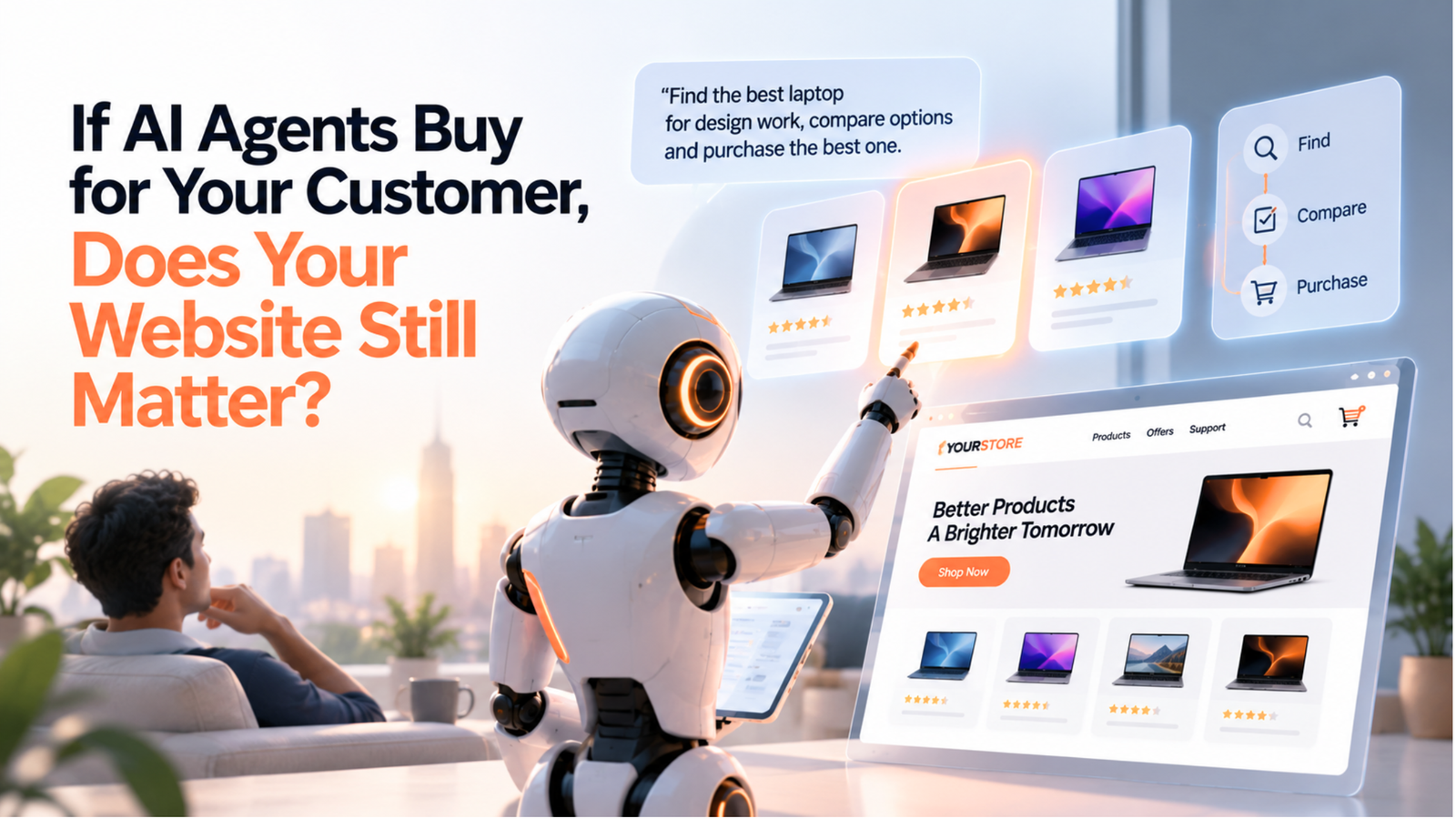
You have a budget, a few requirements and a preferred delivery date. Instead of opening Google, visiting multiple websites and comparing specifications yourself, you simply tell an AI agent:
“Find me the best laptop for video editing under ₹1 lakh. I want at least 16GB RAM, good battery life and delivery this week.”
The agent searches, compares, filters, checks availability and presents a few options.
Perhaps it can even help complete the purchase.
You never had to decide which retailer’s website to visit.
That raises a bigger question for ecommerce:
If AI agents increasingly make shopping easier, does the website still matter?
The answer is yes.
But its role may be changing.
What If the Customer Never Sees Your Homepage?
For years, the ecommerce journey has looked like:
Google → Website → Product Page → Comparison → Cart → Checkout
The emerging journey could look very different:
Customer Request → AI Agent → Product Data → Recommendation → Purchase
In the second scenario, your homepage might never be seen.
Your navigation may never be used.
Your promotional banner may never appear.
Yet your business could still make the sale.
That’s what makes agentic commerce interesting.
The website isn’t necessarily disappearing.
The website visit may simply become optional.
So, What Is the Website For?
If an AI agent can discover and compare products, the website’s role can’t simply be “help people find products.”
It may increasingly serve several purposes.
| Website Role | Why It Matters |
|---|---|
| Product information | AI needs accurate information about what you sell |
| Source of truth | Pricing, availability and policies need to be reliable |
| Brand experience | Customers still need a reason to trust and remember you |
| Trust layer | Customers may visit to verify the business |
| Commerce infrastructure | Products still need to connect to carts, payments and fulfilment |
| Customer relationship | Businesses need to build relationships beyond individual transactions |
The website therefore becomes more than a digital storefront.
It becomes part of the infrastructure behind the storefront.
The Product Page Has a New Problem
A human can understand a product page even when information isn’t perfectly structured.
An AI agent has a harder job.
Consider this description:
“Our premium lightweight running shoe offers exceptional comfort for your everyday runs.”
A person understands the marketing message.
An AI agent needs more specific information:
Weight: 280g
Category: Road running
Material: Mesh upper
Cushioning: Medium-high
Sizes: 6–12
Price: ₹8,999
Stock: Available
Delivery: 2–4 days
Return: 30 days
The distinction matters.
One is designed primarily to persuade.
The other makes the product easier to understand and compare.
The future ecommerce website needs both.
AI May Change What “Good Website Development” Means
For years, businesses have asked:
Is the website fast?
Is it mobile-friendly?
Does it look good?
Does it convert?
Those questions aren’t going away.
But another question is emerging:
Can machines understand it?
An AI-ready ecommerce website may need:
- Clean product data
- Consistent product attributes
- Structured information
- Accurate inventory
- Clear pricing
- Accessible policies
- Reliable APIs
- Search-friendly content
- Machine-readable information
- Secure commerce actions
The customer may never see most of this.
The AI agent might.
The Most Valuable Part of Your Website May Become Invisible
Think of an ecommerce website as having two layers.
The visible layer
Design → Images → Navigation → Content → Brand
The intelligence layer
Product Data → Inventory → Pricing → APIs → Structured Information → Commerce Infrastructure
The first creates the customer experience.
The second makes that experience possible across an increasingly connected digital ecosystem.
This doesn’t mean design becomes less important.
It means good website development now has a deeper technical dimension.
But There Is a Risk for Brands
Imagine an AI agent comparing five similar products.
The customer may see something like:
Product A — ₹8,499
Product B — ₹8,799
Product C — ₹8,999
The AI could reduce a complicated brand experience into a handful of attributes:
Price. Rating. Specification. Availability. Delivery.
That’s potentially difficult for brands whose differentiation depends heavily on storytelling, experience or positioning.
A business can’t assume an AI agent will communicate its value proposition exactly as its marketing team intended.
The brand needs to make its value:
Clear. Consistent. Discoverable.
The Customer May Still Come Back to Your Website
There’s another possibility.
AI may handle discovery, but humans may still want verification.
Imagine an AI tells you:
“This company offers the product you need at ₹42,000 with free delivery.”
Before paying, you may still visit the website.
You want to know:
- Who are they?
- Do they look legitimate?
- What is their return policy?
- What does the product actually look like?
- Do other customers trust them?
- What happens if something goes wrong?
The website could therefore become less of a search destination and more of a trust destination.
And that is a significant change.
Website + WhatsApp Could Become One Journey
This shift also changes how businesses should think about digital channels.
A customer might discover a product through AI search, visit the website and then have a question.
Instead of filling out a traditional contact form, they could start a WhatsApp conversation.
The journey could become:
AI Discovery → Website → WhatsApp → AI-Assisted Qualification → Human Conversation → Purchase
The customer doesn’t care which system handles each stage.
They simply expect the experience to continue.
This is where disconnected systems become a problem.
If someone discovers a product on your website and moves to WhatsApp, the business shouldn’t suddenly lose the context.
The customer shouldn’t have to explain everything again.
This is where platforms such as Wabix can become relevant — connecting WhatsApp conversations, lead information, qualification, automation and human follow-up into one operational workflow.
The New Competitive Question
Ecommerce competition used to revolve around:
Who can build the better website?
The emerging question could be:
Who can make their business easiest for both humans and AI systems to understand and transact with?
| Old Question | New Question |
|---|---|
| Can customers find our website? | Can AI systems discover our products? |
| Is our homepage attractive? | Is our business understandable beyond the homepage? |
| Does our product page convert? | Can our product information be interpreted reliably? |
| Can customers check out? | Can commerce systems support new purchasing interfaces? |
| Do we rank on Google? | Are we visible across AI-driven discovery? |
| Do we have a chatbot? | Can our entire customer journey work intelligently? |
Traditional ecommerce principles aren’t disappearing.
Another layer is being added.
Don’t Build an “AI Website” Just for the Sake of It
There’s already a temptation to put AI everywhere:
AI chatbot.
AI recommendations.
AI content.
AI search.
AI assistant.
But an AI-ready website doesn’t necessarily need dozens of AI features.
It needs a strong foundation.
If product information is inaccurate, adding an AI assistant doesn’t solve the problem.
If inventory is unreliable, an AI recommendation can make the experience worse.
If the website is slow, an AI interface doesn’t fix the underlying experience.
If customer data is fragmented, automation simply moves the fragmentation somewhere else.
The foundation comes first.
AI works best when the systems underneath it are already organised.
So, Does Your Website Still Matter?
Yes.
But perhaps we need to stop thinking of the website simply as the place where commerce happens.
It may increasingly become the place where a business’s:
Identity + Information + Trust + Commerce Infrastructure
come together.
The customer might arrive directly.
Google might send them.
An AI assistant might recommend them.
WhatsApp might carry the conversation.
An AI agent might initiate the purchase.
The interface can change.
The underlying business still needs to be:
Discoverable. Understandable. Trustworthy. Ready to transact.
Beyond Prompts Perspective
The interesting question isn’t whether AI agents will replace ecommerce websites.
It is whether the website will remain the centre of the ecommerce experience.
For some businesses, it probably will.
For others, customers may increasingly encounter the brand through search, AI assistants, social platforms, marketplaces or messaging before they ever see the homepage.
That means website development is entering an interesting phase.
We’re moving from:
“Build a website people can visit.”
towards:
“Build a digital business that people — and the systems helping them — can understand and interact with.”
Your next customer might arrive through a browser.
They might arrive through WhatsApp.
They might arrive through Google.
Or they might arrive through an AI agent that has already compared ten competitors before bringing your business into the conversation.
The website still matters.
But the bigger question is no longer: