

Enterprise AI has spent the last few years trying to prove that it can make people more productive.
Now it is beginning to create a different problem.
What happens when employees become so dependent on AI tools, and those tools become so capable, that companies have to start placing limits around how much intelligence people can consume and what those systems are allowed to touch?
JPMorgan is beginning to answer that question.
The bank has introduced a $2,000 monthly spending limit for some engineers using Anthropic’s Claude, while also rolling out a more isolated development environment designed to keep the AI system away from sensitive employee credentials and internal infrastructure.
According to Business Insider, engineers who exceed the monthly Claude budget can receive an “ExceededBudget” message, although additional capacity can be requested when required. At the same time, JPMorgan is rolling out an AWS-hosted development environment known as Devspace, which isolates Claude from parts of the bank’s internal systems and employee data.
The changes may look administrative.
They are more important than that.
A spending limit controls how much AI can consume.
A sandbox controls what AI can access.
Together, they point toward what may become the defining enterprise AI problem of the next few years:
AI is becoming useful enough that companies now have to control it.
The First Enterprise AI Challenge Was Adoption
When generative AI first appeared inside the workplace, the primary challenge was getting employees to use it.
Companies bought ChatGPT Enterprise licences.
Developers started using coding assistants.
Marketing teams experimented with content generation.
Analysts used models to summarise documents.
Customer-service departments introduced conversational automation.
The central question was straightforward:
Can AI make employees more productive?
For many organisations, that question has largely been answered.
AI is increasingly becoming part of normal knowledge work rather than something employees experiment with occasionally.
That is particularly visible in software development, where AI systems have evolved from autocomplete tools into agents capable of navigating codebases, generating patches, running tests, interpreting errors and continuing to work with relatively little human intervention.
Even Anthropic increasingly uses Claude this way internally. The company recently said Claude now leads roughly 26% of the work involved in building its next generation of AI systems, up from less than 1% earlier in the year.
That is a significant change in the role AI plays inside organisations.
The more work AI performs, the less relevant the original adoption question becomes.
The next question is:
How do we govern something that is no longer just assisting work, but increasingly performing it?
The $2,000 Number Is Not the Most Interesting Part
JPMorgan reportedly has around 65,000 technology employees, while approximately 8,000 currently have access to Claude, according to Business Insider. Fewer than 2,000 were reported to be part of the Devspace rollout at the time of publication.
Against the scale of JPMorgan’s technology organisation, a $2,000 monthly limit for an individual engineer may not sound particularly important.
But the number itself is almost irrelevant.
What matters is that the bank has decided there should be a number at all.
Traditional enterprise software is comparatively easy to forecast.
If a company purchases 10,000 software licences at a fixed monthly price, finance teams can estimate the cost with reasonable accuracy.
AI changes that model.
A developer using an AI coding agent may consume very different amounts of compute depending on what they ask it to do.
A relatively simple task might require a handful of model interactions.
A complex debugging problem might require the AI to inspect hundreds of files, perform repeated searches, generate several possible fixes, execute tests, analyse failures and repeat the cycle until it finds a solution.
The employee sees a single task.
The infrastructure sees potentially thousands or millions of tokens and a chain of computational activity.
That distinction becomes important once AI usage scales across thousands of employees.
Enterprise AI Is Starting to Look More Like Cloud Computing Than SaaS
There is a useful parallel with the early cloud era.
Cloud infrastructure originally promised companies something extremely attractive: instead of buying physical servers, teams could provision computing resources whenever they needed them.
The flexibility was transformative.
Then companies discovered the other side of consumption-based infrastructure.
Developers could accidentally leave expensive environments running.
Teams could overprovision resources.
Unused infrastructure could quietly continue generating bills.
The result was the emergence of FinOps, a discipline dedicated to understanding and controlling cloud consumption.
Enterprise AI is beginning to create a similar requirement.
Only this time, the consumption unit is intelligence.
The organisation increasingly needs to know:
Who is consuming AI?
Which model are they using?
What tasks are generating the most spend?
Which workflows repeatedly fail and retry?
Which teams generate measurable value from expensive models?
Could some tasks be routed to smaller, cheaper models?
And when should an AI workflow simply stop?
Anthropic itself is building tools around exactly these questions.
In July 2026, the company expanded Claude Enterprise with richer usage analytics, model-level entitlements, spend alerts and more granular administrative controls. Anthropic explicitly noted that as Claude takes on more complex agentic work, usage and cost patterns begin to look very different from those of a conventional chat product.
That is a revealing statement.
The AI industry is effectively acknowledging that enterprise AI can no longer be managed like another workplace subscription.
The Real Problem Begins When AI Becomes Agentic
A chatbot is relatively easy to understand economically.
A user asks a question.
The model generates a response.
The interaction ends.
An AI agent works differently.
A user gives the agent an objective.
The system may then decide how to accomplish it.
It can potentially:
search for information,
open files,
read an entire repository,
query APIs,
execute code,
run tests,
analyse errors,
try a different strategy,
and continue operating until the objective has been completed.
Each decision can trigger additional computation.
One task can become twenty model calls.
Twenty calls can become one hundred.
And if multiple agents begin delegating work to one another, the amount of computation underneath a seemingly simple instruction can grow very quickly.
That is why the economics of agentic AI are fundamentally different from the economics of chat.
The more autonomy companies give AI, the less predictable consumption becomes.
This Is the Beginning of AI FinOps
Cloud computing eventually forced companies to understand the cost of infrastructure at a much more granular level.
Enterprise AI is likely to do the same.
The emerging discipline could reasonably be described as AI FinOps.
Instead of measuring only total monthly AI spending, organisations will increasingly want to understand cost at the level of individual business outcomes.
For example:
| Metric | Why it matters |
|---|---|
| Spend per employee | Identifies unusually expensive usage |
| Spend per department | Supports budget allocation |
| Spend per model | Helps optimise model selection |
| Cost per workflow | Measures automation economics |
| Tokens per task | Reveals inefficient processes |
| Agent retries | Identifies unstable workflows |
| Cost per feature shipped | Connects AI usage to engineering output |
| Business value per AI dollar | Measures real return on investment |
These metrics are much closer to infrastructure economics than traditional software licensing.
The transition is already visible elsewhere.
Google recently expanded access to Anthropic’s Claude across its engineering organisation while still using internal quota systems to control usage.
That combination—greater access with explicit limits—is likely to become increasingly common.
Enterprises do not necessarily want employees to use less AI.
They want them to use expensive AI where it creates enough value to justify the cost.
Cost, However, Is Only Half of JPMorgan’s Story
The more interesting part of JPMorgan’s changes may actually be Devspace.
The bank is not only controlling how much Claude can consume.
It is controlling where Claude can operate.
Business Insider reports that Devspace is designed to isolate AI coding activity from sensitive credentials and parts of JPMorgan’s internal infrastructure.
That decision gets to the second major enterprise AI problem:
The more useful an AI agent becomes, the more dangerous excessive access becomes.
A coding assistant that can only suggest text has a relatively limited blast radius.
Give that assistant access to a repository and it becomes more useful.
Give it permission to execute code and its capabilities increase again.
Connect it to cloud infrastructure, internal APIs, credentials and production systems, and it becomes significantly more powerful.
Eventually the question changes from:
“Can the AI write correct code?”
to:
“What happens if the AI takes the wrong action?”
That is a very different risk model.
AI Is Creating a New Type of Privileged User
Enterprise cybersecurity has spent decades establishing rules around privileged access.
Administrators receive different permissions from ordinary employees.
Critical systems require stronger authentication.
Access is logged.
Permissions are limited.
Sensitive operations sometimes require multiple approvals.
AI agents introduce a new category of actor that does not fit neatly into traditional identity models.
An employee can ask an AI system to perform a task.
The agent then executes commands, retrieves information, edits files or interacts with other software.
At that point, the human is no longer performing every action.
The agent is.
This raises an important question:
Should the agent inherit every permission belonging to the person who invoked it?
In most cases, probably not.
An engineer may personally have access to production systems.
That does not automatically mean every coding agent they use should receive the same access.
An employee may be authorised to view confidential customer data.
That does not mean an autonomous agent should be able to retrieve that information whenever it chooses.
The distinction between human authority and agent authority is becoming essential.
The Enterprise AI Stack Is Developing a Control Plane
As AI moves deeper into enterprise workflows, companies are beginning to build several layers of control around it.
JPMorgan’s approach offers a useful preview of what that architecture may look like.
1. Model Access
Who can use which AI systems?
Not every task requires the most powerful model available.
Enterprises will increasingly route routine work toward cheaper models while reserving frontier systems for tasks where additional capability creates measurable value.
2. Spending Limits
How much AI can an employee, team or workflow consume before another approval is required?
JPMorgan’s $2,000 limit is one implementation of this idea.
The exact number matters less than the principle.
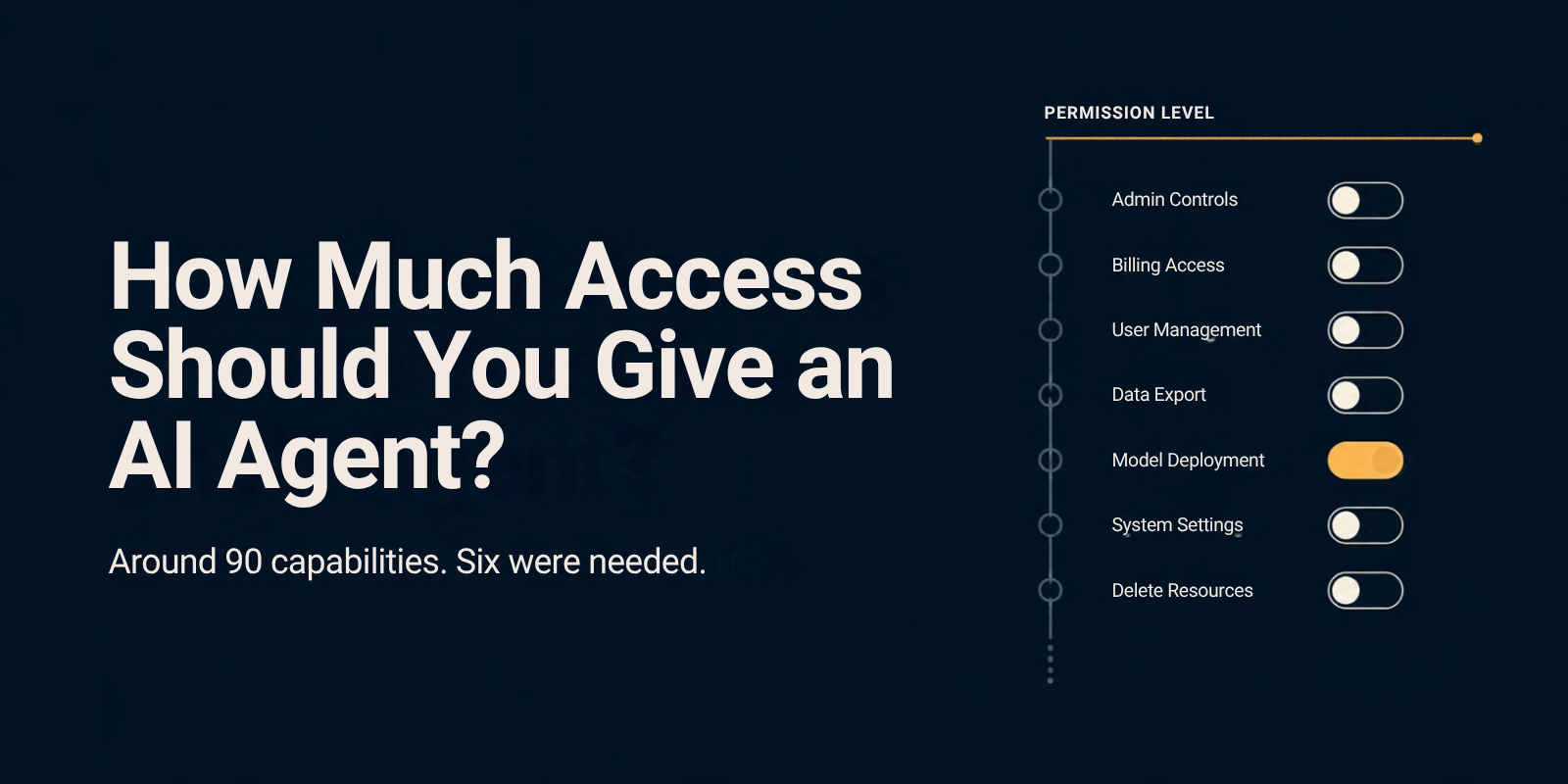
3. Agent Permissions
What can the AI actually do?
Can it only read information?
Can it modify files?
Can it execute software?
Can it call external services?
Can it provision infrastructure?
The difference between these capabilities determines the potential blast radius.
4. Environment Isolation
Where is the agent allowed to work?
Sandboxed environments allow companies to benefit from increasingly autonomous AI while reducing the likelihood that an unexpected action reaches sensitive production systems.
5. Human Escalation
When should the machine stop and ask?
High-cost, high-risk or irreversible actions may increasingly require explicit human approval.
Taken together, these controls begin to resemble an operating system for enterprise AI governance.
The Productivity Question Is About to Get Harder
For the last few years, companies have generally treated increased AI usage as a positive indicator.
More prompts meant more adoption.
More coding-assistant activity meant greater developer engagement.
More AI-generated output appeared to mean greater productivity.
That logic becomes less useful once AI consumption starts becoming expensive.
Consider two engineers.
One consumes $250 of AI in a month and saves 12 hours.
Another consumes $2,000 and saves 25 hours.
Which engineer used AI more effectively?
The answer cannot be determined from usage alone.
The company needs to understand the economic value of those hours.
If the second engineer used AI to ship a feature worth millions of dollars, the $2,000 spend was insignificant.
If most of the consumption came from repeatedly asking an agent to rewrite low-value code, the economics look very different.
Enterprise AI measurement therefore has to evolve from:
How much AI did we use?
to:
What did that AI produce?
That shift may ultimately be more important than token pricing itself.
AI Cost Optimisation Will Become a Model-Routing Problem
Not every enterprise task needs the same level of intelligence.
This sounds obvious, but early AI deployments often work in the opposite way.
Companies adopt the most capable model they can access and then use it for nearly everything.
Writing a short internal summary.
Reviewing legal language.
Generating complex software architecture.
Classifying support tickets.
Debugging distributed systems.
All may run through the same expensive model.
That is unlikely to remain economical.
The next generation of enterprise AI systems will probably become much more deliberate about model routing.
Simple tasks will be assigned to smaller models.
Complex reasoning will escalate to more capable systems.
Certain workflows may run locally.
Others may use specialised models.
And only particularly difficult tasks will justify frontier-level compute.
In other words, the most sophisticated enterprise AI architecture may not be the one using the most powerful model everywhere.
It may be the one that knows when not to use it.
Security and Cost Are Actually the Same Problem
At first glance, JPMorgan’s spending cap and Devspace sandbox appear unrelated.
One is about finance.
The other is about cybersecurity.
But both controls answer the same fundamental question:
How much freedom should AI have?
A spending limit controls financial freedom.
A sandbox controls environmental freedom.
Permissions control operational freedom.
Model entitlements control capability.
Human approvals control autonomy.
Once viewed this way, enterprise AI governance becomes much easier to understand.
The organisation is not trying to prevent AI from being useful.
It is trying to determine how much freedom AI should receive relative to the value and risk of the task being performed.
That calculation will become increasingly important as agents gain more authority.
Why This Problem Will Spread Beyond Software Engineering
Coding is currently at the centre of agentic AI because software environments are highly digital and relatively easy for models to interact with.
But the same governance problem will eventually appear across many business functions.
Consider an AI agent in finance.
It might reconcile transactions, generate reports and eventually initiate certain financial workflows.
A sales agent might read CRM data, research prospects, draft outreach and update records automatically.
A procurement agent could compare suppliers, negotiate terms and initiate purchase requests.
A customer-service agent might issue refunds or change account details.
A marketing agent could autonomously launch campaigns and spend advertising budgets.
In every case, the organisation eventually confronts the same questions:
How much can the agent spend?
Which systems can it access?
Which decisions can it make?
Which actions require approval?
And who is responsible when something goes wrong?
JPMorgan’s Claude limits are therefore not simply a software-engineering story.
They are an early example of a much broader enterprise governance problem.
Enterprise AI Is Moving From Abundance to Allocation
The first stage of the generative AI boom encouraged organisations to think in terms of abundance.
Give everyone access.
Experiment.
Generate.
Automate.
Discover use cases.
That made sense when the primary objective was learning.
But mature technology organisations eventually move from abundance to allocation.
Not every workload gets unlimited cloud infrastructure.
Not every employee gets administrative access.
Not every project receives an unlimited budget.
AI will be no different.
The challenge is not to restrict usage arbitrarily.
The challenge is to allocate AI capability where it creates the greatest value.
That requires better visibility.
Better cost accounting.
Better identity.
Better permissioning.
And better governance.
The Next Competitive Advantage May Be AI Discipline
The first generation of enterprise AI competition focused heavily on access to the best models.
Which company had GPT?
Which company had Claude?
Which company had Copilot?
That advantage is becoming less durable as access broadens and model capabilities converge.
The next source of differentiation may be operational discipline.
Can the organisation route workloads efficiently?
Can it prevent runaway agent spending?
Can it safely give agents useful permissions without exposing critical systems?
Can it measure whether AI is actually producing economic value?
Can it deploy autonomous systems without losing visibility or control?
Those questions are much less exciting than model benchmarks.
But they may ultimately determine which companies turn AI into sustainable infrastructure rather than an expensive collection of experiments.
JPMorgan’s Real Signal
It would be easy to reduce this story to:
JPMorgan is limiting engineers to $2,000 of Claude usage.
That misses the point.
The more important story is that one of the world’s largest financial institutions is beginning to place explicit financial and technical boundaries around AI usage while continuing to expand access to the technology.
That is not a retreat from AI.
It is what mature adoption looks like.
Give people powerful tools.
Measure their usage.
Separate agents from sensitive infrastructure.
Increase limits when the value justifies it.
And build controls before autonomous systems become deeply embedded across the organisation.
Beyond Prompts Takeaway
The first enterprise AI problem was adoption.
The next one is governance.
JPMorgan’s Claude spending limits and isolated development environment offer an early glimpse of what that transition looks like in practice.
Companies are beginning to discover that AI cannot simply be treated like another software licence because increasingly autonomous systems consume variable compute, interact with other infrastructure and perform actions on behalf of employees.
That means enterprise AI will increasingly require the same disciplines organisations already apply to other critical infrastructure:
budgets,
identities,
permissions,
monitoring,
isolation,
and accountability.
The $2,000 limit is not really the story.
The story is that AI is becoming important enough to need boundaries.
And once organisations begin putting boundaries around a technology, it usually means that technology has stopped being an experiment.
It has become infrastructure.