
For most people, generative AI still means opening a chatbot, typing a question, waiting for an answer, and then copying that response somewhere else. It is useful, but it is not always natural.
iOS 27 could change that.
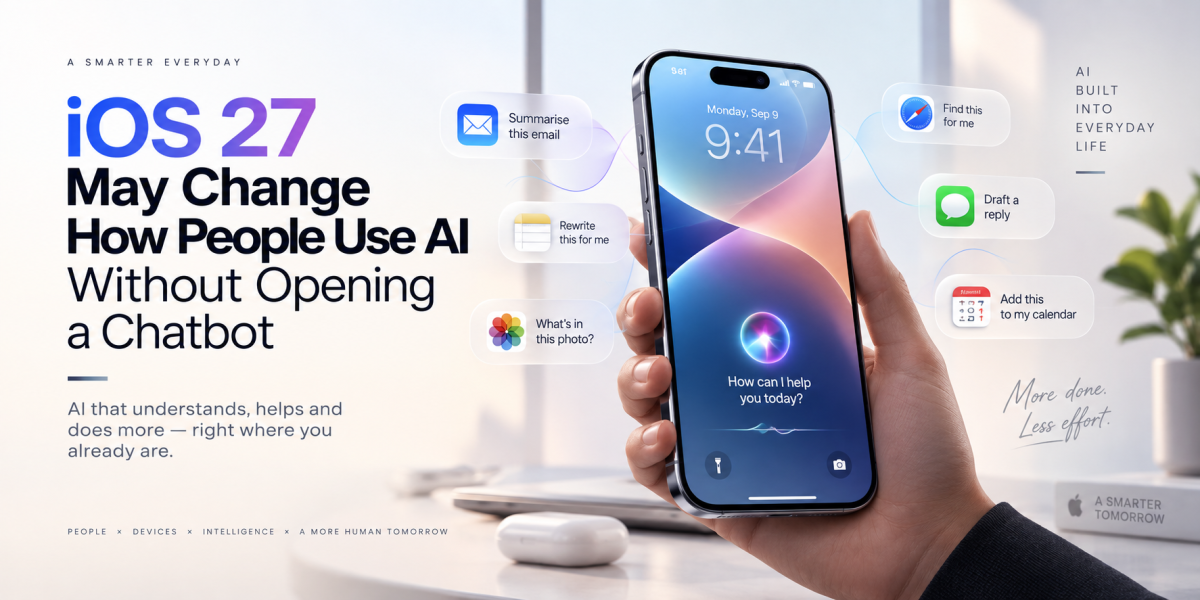
Instead of making AI feel like a separate app, Apple appears to be moving it deeper into the iPhone experience itself. With Siri AI and the next generation of Apple Intelligence, AI may start helping users inside the apps, screens, messages, photos, emails, and tasks they already use every day.
That shift matters because the future of AI may not be about opening a chatbot. It may be about the phone quietly helping at the right moment.
In simple terms, iOS 27 could move AI from being a destination to becoming a layer inside daily digital life.
The Chatbot Was Only the Starting Point
Chatbots made AI easy to understand because they gave people one clear place to ask for help. Users could write emails, summarize reports, create captions, plan ideas, or solve small problems from one simple prompt box.
But the chatbot model has friction.
A user has to leave what they are doing, open another app, explain the context, generate the answer, and then bring that answer back into the original task. For regular users, that extra effort can make AI feel useful but not seamless.
This is where iOS 27 becomes interesting. If AI is available through Siri, search, mail, messages, photos, camera, calendar, notes, and on-screen context, users may not need to “go to AI” anymore.
They may simply continue what they are doing, while the phone helps in the background.
AI Moves Into the Interface
The bigger story is not just that Siri may become smarter. The bigger story is that AI may become more ambient.
Ambient AI means intelligence is available inside the user’s normal flow instead of sitting inside a separate chatbot window. The phone already has context: the app being used, the message being written, the photo being viewed, the email being read, or the task being planned.
That context can make AI feel more practical.
A user could ask the phone to summarize a long email, rewrite a message, find an old file, understand a photo, suggest a reply, or help plan a task without switching between apps.
That is a different kind of AI experience.
Not “open AI and ask.”
But “use your phone, and AI helps there.”
What Changes for Everyday Users
For everyday users, the value of AI is not always about the most advanced model. It is about reducing effort at the right moment.
| Everyday Task | Chatbot Experience | iOS 27-Style Experience |
|---|---|---|
| Reading a long email | Copy it into a chatbot | Summarize inside the phone experience |
| Writing a reply | Draft elsewhere and paste back | Rewrite directly inside the app |
| Searching for old information | Manually check apps and folders | Ask naturally across phone context |
| Looking at a photo or document | Upload it to another AI tool | Ask about what is already on the device |
| Planning a task | Get advice from a chatbot | Connect it with reminders, calendar, or messages |
This is where AI becomes more mainstream. When it is easier to access, people use it for smaller moments. When they use it for smaller moments, it becomes a habit.
And once AI becomes a habit, it stops feeling like a special tool.
It starts feeling like normal technology.
The Real Product Is Trust
Apple’s biggest challenge is not only making Siri more capable. It is making users comfortable with AI working close to their personal data.
The iPhone is deeply personal. It contains messages, photos, contacts, financial apps, work files, health data, notes, passwords, location history, and private conversations.
So if AI becomes more integrated into the phone, users need to trust how their data is handled.
This is where Apple’s privacy-first positioning becomes important. The company is not simply trying to build another chatbot. It is trying to make AI feel safe enough to live inside the most personal device people own.
That gives Apple an advantage, but it also creates a high bar.
The more personal AI becomes, the more careful it must be.
The Phone Becomes the AI Platform
For years, mobile behavior has been built around apps. You open one app to message, another to search, another to write, another to book, another to find files, and another to manage work.
AI could slowly change that pattern.
Instead of asking, “Which app should I open?” users may start asking, “What do I want done?”
Apps will not disappear. They will still hold workflows, data, permissions, and brand experiences. But the assistant layer may become more important because it helps users move across apps with less effort.
That is why iOS 27 matters. It could make the iPhone feel less like an app launcher and more like an intelligent action layer.
Why Businesses Should Pay Attention
The impact of iOS 27 is not limited to Apple users. It also signals a bigger shift in user expectations.
When people get used to smarter assistance on their phones, they will expect similar intelligence from websites, apps, customer support systems, and workplace tools.
| Business Area | What Users May Expect |
|---|---|
| Customer support | Faster answers with context |
| Mobile apps | Fewer steps and smarter suggestions |
| Websites | Guided experiences instead of static navigation |
| Search | Natural-language answers, not only links |
| Forms | Less repetition and smarter pre-fill |
| Internal tools | Less copy-paste and more automation |
This matters for every business building digital experiences.
If consumer technology becomes smarter, business technology cannot stay slow, disconnected, and manual.
But Invisible AI Must Be Clear
There is one risk.
When AI becomes part of the background, users may not always know when AI is being used, what data it is using, or why it is making a suggestion.
That can create confusion, especially when AI is involved in emails, documents, search results, recommendations, or sensitive personal information.
Convenience should not remove control.
Users need to know when AI is assisting them, when personal context is being used, and when a suggestion needs review. They should be able to correct, reject, or turn off AI when needed.
The best AI interfaces will not only be powerful. They will be understandable.
Beyond Prompts Perspective
The most interesting thing about iOS 27 is not simply that Apple is adding more AI features.
The bigger shift is where AI lives.
When AI lives inside a chatbot, it feels like a separate destination.
When AI lives inside the phone, it starts to feel like part of everyday life.
That is the real change.
AI is moving from a place people visit to a layer that supports what they are already doing.
For users, this means less switching and more assistance.
For businesses, it means higher expectations.
For technology companies, it means the interface itself is becoming intelligent.
Final Thought
iOS 27 may show that the future of AI is not always loud, dramatic, or separate.
Sometimes, the future is quieter.
It is the phone helping you write a better message.
It is the assistant understanding what is on your screen.
It is search becoming more natural.
It is a task becoming easier without opening another app.
For millions of people, AI may become normal not because they download a new chatbot, but because the device they already use every day becomes more intelligent.
That may be the real story of iOS 27.
Not AI as a separate habit.
AI as part of the interface.