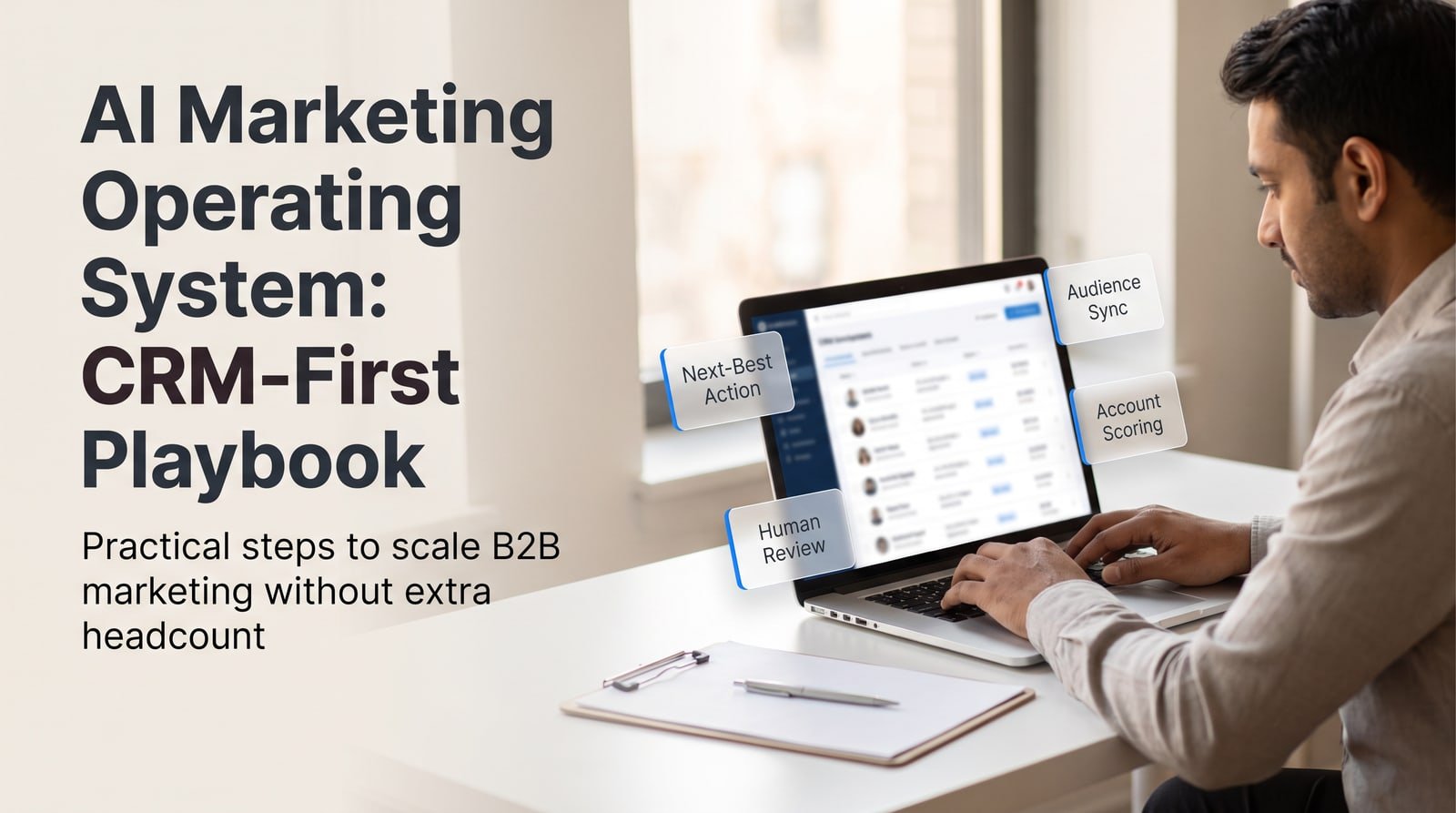

Many mid-market B2B marketing teams hit the same wall: execution capacity. An AI marketing operating system can change that by automating routine work, surfacing priority signals from your CRM, and coordinating campaigns without adding headcount.
This playbook explains what an AI marketing operating system is, how a CRM-first deployment works in Salesforce and HubSpot, and which governance and procurement artifacts you need to move from pilot to predictable value. Expect practical checklists, templates to request from your vendor, and clear steps your team can run this quarter.
If you manage a lean B2B marketing function, this guide gives an implementation-first path: set a clear data model, wire low-code connectors, add human-in-the-loop controls, and measure headcount-equivalent impact so procurement can assess TCO.
What is an AI marketing operating system?

An AI marketing operating system (AI Marketing OS) is the orchestration layer that connects planning, execution, measurement and optimization across tools and teams. Unlike single-purpose point tools, the OS coordinates workflows so strategy and execution share the same governed process.
According to MarktG, "An AI Marketing OS is the operating layer that connects strategy, execution, measurement, and optimization into one governed workflow." That sentence captures the core difference: the OS does not replace every tool but wraps them with a consistent lifecycle and policy layer.
Core lifecycle — Plan → Execute → Measure → Optimize
The AI Marketing OS lifecycle is a continuous loop: Plan → Execute → Measure → Optimize. First you set strategy (target segments, offers, KPIs), then the OS turns strategy into repeatable execution recipes (campaign templates, content variants, ad recipes). Measurement feeds back normalized signals into scoring and attribution. Finally, optimization rules adjust future plans and campaign parameters.
This lifecycle lets teams trace actions to outcomes: campaign templates are versioned, rules show why an action fired, and measurement tiles map back to the CRM. It reduces friction between strategy and delivery and shortens the time from idea to measurable outcome. MarktG describes the Plan → Execute → Measure → Optimize loop as the AI Marketing OS lifecycle.
How an OS replaces vs. integrates with point tools
Most teams already use many point tools: CRM, analytics, content editors, ad platforms, email, dashboards, and AI assistants. The OS either centralizes capabilities that need consistent governance or orchestrates when best-of-breed point tools remain preferable.
| Role | Point tools (common examples) | How OS handles it |
|---|---|---|
| CRM | Salesforce, HubSpot | OS treats CRM as the system of record for contacts/accounts and drives next-best-actions from CRM signals |
| Content & Creative | CMS, content editors, AI writing assistants | OS templates content workflows, version control, and QA rules; delegates creation to tools but centralizes approval |
| Paid Media | Google Ads, LinkedIn Ads | OS orchestrates ad triggers and audience updates, uses connectors to sync segments and conversions |
| Analytics / Dashboards | BI tools, GA, Data Studio | OS ingests measurement events and normalizes metrics for attribution and optimization rules |
Use the OS to centralize policy, templates, and decision rules while keeping specialized tools for their strengths. This reduces marketing tool sprawl without mandating a single-vendor rewrite.
Why lean B2B teams need an AI Marketing OS

Small marketing teams face three practical constraints: limited hours, fragmented measurement, and slow campaign cycles. An AI Marketing OS helps by automating repetitive tasks, surfacing which accounts matter now, and turning playbooks into executable recipes.
Benefits for small marketing teams include faster campaign velocity, less manual segmentation and reporting, and clearer account prioritization. These gains let teams run more experiments without hiring additional staff, and they make campaign outcomes reproducible across channels.
Common capacity bottlenecks an OS solves
Repetitive work that consumes small teams includes segment creation, A/B content variants, reporting assembly, and manual audience syncs. An AI Marketing OS automates many of these tasks and hands higher-risk decisions to reviewers.
Common headcount-equivalent workstreams to automate:
- Segment assembly and audience syncs to ad platforms
- Content variant generation and QA routing
- Consolidated reporting and attribution rollups
For a practical product perspective, see IrizPro’s product overview for how a cMOS connects CRM signals to execution: IrizPro products.
Realistic expectations for time-to-value (qualitative guidance)
Time-to-value depends on CRM cleanliness, connector readiness, and the chosen pilot use case. Typical first wins are automated audience syncs and a single next-best-action campaign seeded from the CRM. For exact numeric benchmarks, include client-verified metrics and vendor-supplied procurement materials in your procurement package.
CRM-first implementation playbook: Salesforce & HubSpot

A CRM-first approach makes the CRM the source of truth for accounts, contacts, consent, and attribution events. The OS reads CRM signals, scores accounts, and triggers actions while writing outcomes back to the CRM for closed-loop measurement.
Required data schema and hygiene checklist
Before wiring connectors, confirm minimum data elements and ownership. Do not hardcode field names without aligning to your engineering or implementation lead.
| Data element | Purpose | Who owns it |
|---|---|---|
| Account score | Prioritize accounts for next-best-action | Marketing/RevOps |
| Engagement events | Trigger campaigns from email/website interactions | Marketing Ops |
| Contact consent | Ensure compliant outreach | Legal/Compliance |
| Campaign attribution | Tie outcomes back to campaigns | Analytics/Marketing Ops |
Ask engineering to map these data elements to your CRM objects and confirm naming conventions before implementation.
Low-code connector checklist (Zapier/Workato/Make examples)
Connector tasks to check before go-live:
- Authentication: OAuth or API key with least privilege
- Field mapping: map each data element and date format
- Error handling: dead-letter queue or alerting on failed syncs
- Sync cadence: near-real-time for intent signals; batched for large exports
- Retry logic: exponential backoff and dedup keys
For implementation perspective and connector strategy, review IrizPro’s cMOS approach: IrizPro cMOS.
Common configuration pitfalls & troubleshooting pointers
Watch for duplicate records, stale segmentation logic, mismatched attribution windows, and permission scope issues. Quick remediation steps:
- Run a dedupe job and validate unique IDs before syncing
- Test segmentation logic with a sandbox cohort
- Confirm attribution windows between ad platforms and CRM
- Validate API scopes and impersonation rights for connectors
Run end-to-end test cases: create a test account, simulate engagement events, and confirm the action path and attribution writeback.
Governance & human-in-the-loop templates (AI risk controls)
Governance keeps AI outputs aligned with brand, compliance, and legal requirements. A lightweight, risk-based governance model gives teams clear rules on what to automate and what to review.
Risk-tiered decisioning (what to automate vs review vs approve)
Adopt a triage model: low, medium, high risk. According to MarktG, "Human Command implements risk-tiered controls: low-risk actions can be automated, medium-risk actions recommended for review, and high-risk actions require approval." Use this model to assign approval steps to each action the OS might take.
Low risk: automated (internal reports, drafting)
Medium risk: recommended for review (creative variants, segmentation changes)
High risk: approval required (strategic budgets, regulated claims)
Templates to include in the downloadable toolkit
Package these artifacts for pilots:
- Approval workflow diagram (who signs off at each risk tier)
- Content QA rubric (tone, factual checks, regulated claims)
- Compliance checklist (consent fields, storage rules)
- Decision log template (who triggered the action and why)
See IrizPro governance examples and policies for client use cases: AI usage policy examples. You can review these templates on IrizPro's site.
Alignment with AI risk frameworks
Map your governance approach to the NIST AI RMF. The arc42 model explains that the AI RMF core is organized into four functions that form a full AI risk management lifecycle, and that GOVERN is a cross-cutting function whose policies apply across MAP, MEASURE, and MANAGE. See the arc42 explanation for reference: arc42 — NIST AI RMF. For official roadmap context, reference the NIST AI RMF roadmap page: NIST AI RMF roadmap.
Decision intelligence & next-best-action workflows
Decision intelligence links signals to actions. The OS ingests intent and engagement signals, applies scoring and governance rules, and triggers the next-best-action.
Example workflow (signal → score → action)
A typical pseudo-flow:
- Signal ingestion: web intent, email opens, CRM touchpoints
- Scoring/ranking: normalize signals into a rank (SCORE_THRESHOLD_A placeholder)
- Rule check: governance tier and consent flags
- Action: send email variant, update ad audience, or create SDR task
- Measurement: writeback outcomes to CRM for attribution and next-loop optimization
Use placeholder variables (e.g., SCORE_THRESHOLD_A) and confirm thresholds with your implementation lead.
Pseudo-code / low-code rules examples
Three high-level rule examples using placeholders:
- IF engagement_signal = "high" AND consent = true THEN recommend_action = "email_variant_A"
- IF account_score > SCORE_THRESHOLD_A AND last_touch < DAYS_SINCE_ENGAGEMENT THEN create_task = "SDR outreach"
- IF campaign_attribution = "unassigned" AND conversion_event = true THEN tag_lead = "auto-attrib"
If available, add orchestration screenshots from your vendor to help operators map rules to UI.
For connecting reports to execution and closing the loop, see IrizPro insight on linking reports to action: Connect reports to execution.
TCO, procurement talking points & measuring headcount impact
Procurement needs a clear pack: deployment timeline, milestone owners, SLA expectations, training plan, and anonymized case metrics. Frame TCO qualitatively until you can supply client-verified numbers.
What to include in a procurement pack
Recommended items for vendor evaluation:
- Deployment timeline and implementation milestones
- SLA and support model details
- Training and enablement for Ops and RevOps
- Anonymized pilot metrics and methodology notes
- Security and data access controls
Direct procurement readers to the product overview and suggest they request a demo or additional product materials: IrizPro products — or contact IrizPro via Contact Us.
How to measure headcount-equivalent savings (methodology)
A reproducible methodology:
- Capture time spent on tasks (time logs or surveys)
- Map tasks to automation coverage (which tasks the OS will handle)
- Estimate hours saved (placeholder: populate with client case numbers)
- Translate hours saved into FTE-equivalent using your organization's FTE hours definition
| Metric | How to capture | Use case |
|---|---|---|
| Task hours logged | Time tracking or manual logs | Baseline for automation |
| Automation coverage | Feature mapping | What portion can be automated |
| Hours saved estimate | Multiply coverage × hours | Placeholder for client numbers |
| FTE-equivalent calculation | Hours saved ÷ org FTE hours | Use procurement calculator |
Use a TCO spreadsheet (from your vendor or procurement) to model exact savings for your ARR and media mix.
Suggested KPIs & dashboards
Monitor:
- Time to campaign (from idea to live)
- Campaign throughput (campaigns per month)
- Pipeline influenced (CRM opportunities tied to campaigns)
- Attribution rate and error/fail rate
Map each KPI to CRM fields or event sources so dashboards show live operational health.
Frequently Asked Questions
Conclusion
An AI marketing operating system is an orchestration layer that aligns planning, execution, measurement and optimization for repeatable campaigns. For 2–8 person B2B teams, a CRM-first deployment reduces manual work, speeds campaign velocity, and makes prioritization clearer.
Success depends on clean CRM data, disciplined low-code connector work, risk-tiered governance, and a decision-intelligence approach that maps signals to actions. Package governance templates and a procurement-ready TCO pack before pitching procurement.
To explore how a CRM-seeded pilot could work for your team, review IrizPro’s product capabilities or request a demo and product materials: IrizPro products — or request a demo via Contact Us.