
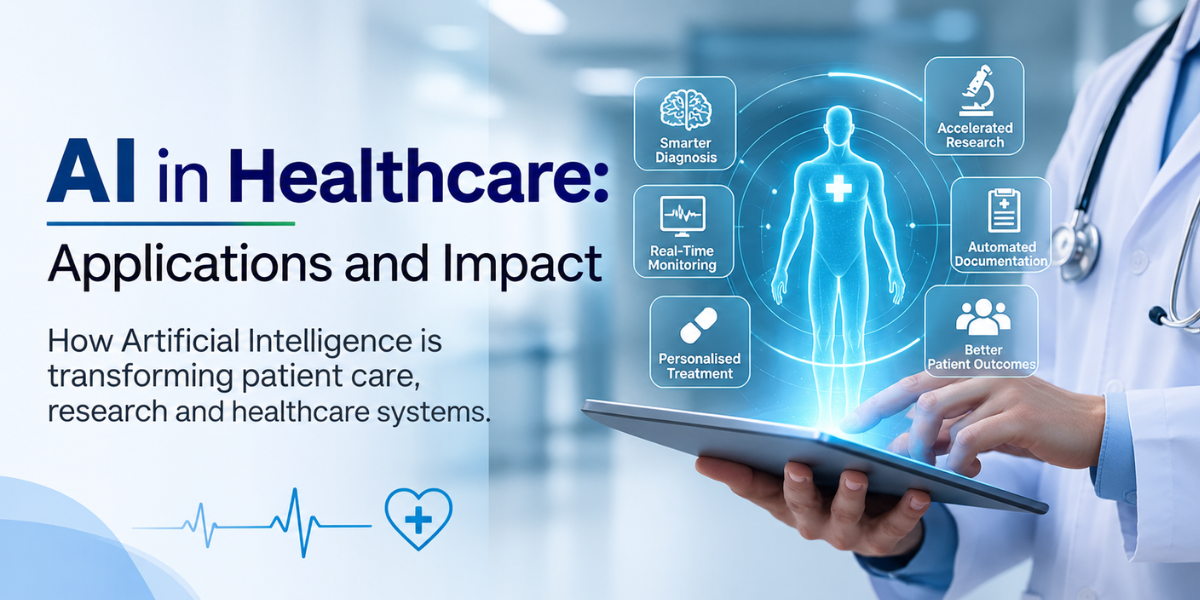
AI in healthcare has moved from pilot projects to everyday clinical tools. Hospitals use it to read scans, clinics use it to cut paperwork, and researchers use it to find new drug candidates. This guide explains how AI is used in healthcare, what impact it is having, and where its limits lie.
AI in healthcare means software that learns from medical data to support diagnosis, treatment, research and administration. Its biggest footprint today is medical imaging, where the FDA has authorized well over a thousand AI-enabled devices. The impact shows up as faster scan reads, less paperwork and earlier risk detection. The limits are bias, privacy and over-reliance, which is why clinicians stay in charge.
What Is the Role of AI in Healthcare?
The role of AI in healthcare is to help clinicians and health systems find patterns in large volumes of data faster than people can. That data includes images, lab results, health records and the free text of clinical notes.
Artificial intelligence (AI) in health care works best as a second pair of eyes, not a replacement for a doctor. An algorithm flags a suspicious shadow on a chest X-ray, and the radiologist decides what it means. A language model drafts a visit summary, and the physician edits and signs it. Across specialties the pattern repeats: AI proposes, humans decide.
The growing role of artificial intelligence in healthcare is visible in policy too. The World Health Organization’s January 2024 guidance on large multi-modal models, a type of generative AI, names five broad uses in health: diagnosis and clinical care, patient-guided use, clerical and administrative tasks, medical and nursing education, and scientific research and drug development.
How Is AI Used in Healthcare Today?
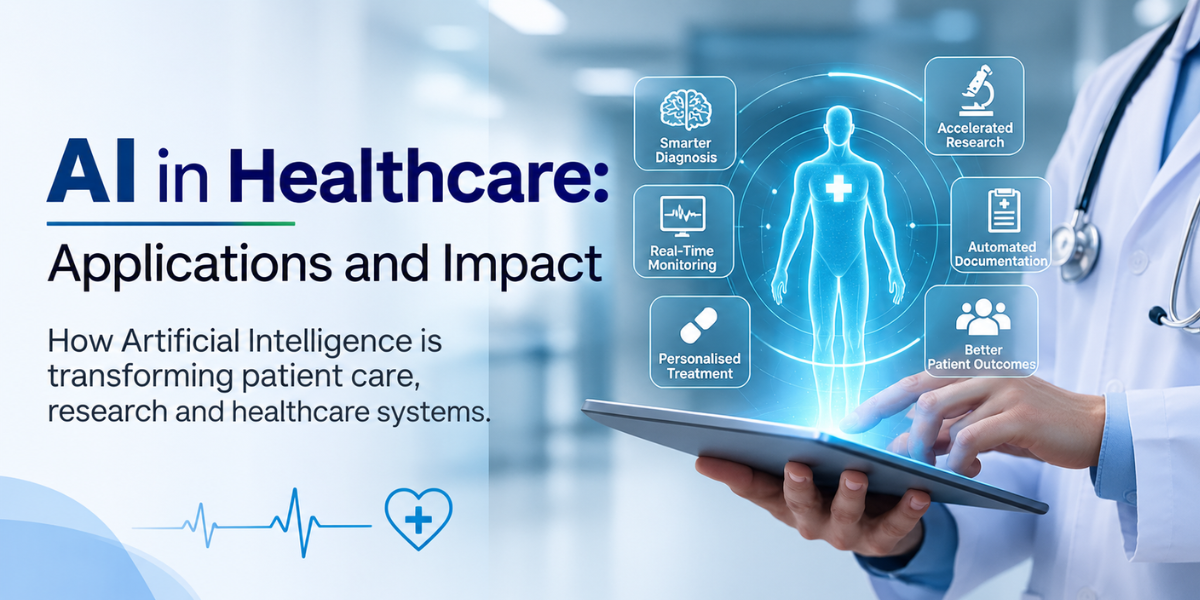
AI is used in healthcare today for medical imaging, clinical documentation, risk prediction, drug discovery and patient communication. These five areas cover most real-world deployments.
- Medical imaging and diagnostics. AI tools help read X-rays, CT scans, MRIs and mammograms by highlighting areas that need a closer look. Radiology accounts for 1,094 of the 1,430 AI and machine learning-enabled devices the FDA authorized between 1995 and December 2025, about 76.5%, according to a medRxiv preprint that has not yet been peer reviewed.
- Clinical documentation and administration. Ambient scribes draft visit notes, and automation handles scheduling, coding and prior authorizations. The goal is simple: give clinicians time back for patients.
- Predictive analytics. Models scan vital signs and records to flag patients at risk of deterioration, sepsis or readmission. Their value depends on validation against the hospital’s own patient population.
- Drug discovery and research. AI helps screen compounds, predict protein structures and match patients to clinical trials, which narrows the early search for promising treatments.
- Virtual assistants and remote monitoring. Chatbots handle symptom triage and medication reminders, while wearables stream data that algorithms watch for warning signs.
What Impact Is AI Having on Patients and Providers?
AI is making care faster and more proactive for patients and lighter on paperwork for providers. The evidence is strongest in imaging and weaker for broad claims about long-term outcomes.
For patients, the benefits are quicker results, earlier detection and wider access where specialists are scarce. For providers, they are prioritized worklists and less time spent typing. For health systems, they are better scheduling and capacity planning. Many tools are authorized on technical performance, so outcome evidence still varies by product.
AI can also extend scarce expertise. In regions with few radiologists or specialists, tools that triage scans or screen for common conditions help decide who needs urgent attention first. They still depend on reliable data, connectivity and local validation.
| Group | Main benefit | Main watch-out |
| Patients | Faster results, earlier detection | Unequal performance across populations |
| Clinicians | Less documentation, prioritized worklists | Over-reliance on AI output |
| Health systems | Smarter scheduling and capacity planning | Integration cost and data quality |
What Are the Risks of Artificial Intelligence in Health Care?
The main risks are biased training data, privacy and cybersecurity exposure, inaccurate generated output and automation bias. The WHO has warned that large multi-modal models can produce misleading, inaccurate, biased or incomplete information that may harm health decisions.
Concentration is a risk as well. Because AI device approvals cluster in radiology, many specialties have far fewer validated tools. The practical safeguards are consistent: validate tools on local data, keep a clinician in the loop, audit performance after launch and be transparent with patients about when AI is involved.
What Does AI in Healthcare News Today Really Tell Us?
Most AI in healthcare news falls into three buckets: regulatory decisions, new clinical tools, and funding or adoption announcements. Regulator data is the most reliable way to judge the pace of change.
One example is the FDA’s public list of AI-enabled devices. An analysis of that list by a regulatory law blog counted 10 authorizations in the first ten years and 253 in 2024 alone.
What Should Healthcare Organizations Do Next?
Healthcare organizations should start with one clearly defined problem rather than a broad AI strategy. A practical sequence works well:
- Pick a specific problem, such as radiology turnaround time or documentation burden.
- Validate the tool on your own patient data before rollout.
- Keep clinicians responsible for final decisions.
- Set governance for monitoring, privacy and incident reporting.
The organizations that benefit most treat AI as a workflow change, not a software purchase. Training, clear ownership and honest measurement of results matter as much as the algorithm. Done well, AI in healthcare becomes a quiet, dependable layer of support. Talk to our team about an AI readiness review
Frequently Asked Questions
What is the role of AI in healthcare?
The role of AI in healthcare is to support clinicians by analyzing medical data at scale. It helps read images, predict patient risk, automate documentation and speed up research. AI assists clinical judgment rather than replacing it, and a qualified professional remains responsible for diagnosis and treatment decisions.
How is AI used in healthcare?
AI is used in healthcare for medical imaging, clinical note-taking, risk prediction, drug discovery and virtual assistants. Radiology is the most mature area, accounting for roughly three-quarters of FDA-authorized AI and machine learning devices, while administrative automation is growing quickly across hospitals and clinics.
Will AI replace doctors?
No. AI in healthcare is designed to assist doctors, not replace them. It can flag findings and draft documents, but it lacks clinical judgment, accountability and patient context. Regulators and the WHO emphasize human oversight, so clinicians stay responsible for final decisions about diagnosis and care.
Is AI in healthcare safe?
AI in healthcare can be safe when it is validated, monitored and used with human oversight. Risks include biased data, inaccurate output, privacy breaches and over-reliance. Tools authorized by regulators have been reviewed, but hospitals should still test them on their own patients and audit results over time.
Where can I find AI in healthcare news?
For reliable AI in healthcare news, start with regulator and public-health sources such as the FDA’s AI-enabled device list and WHO publications, then add peer-reviewed journals and trade outlets like MedTech Dive. Treat vendor press releases cautiously and check whether a tool is authorized, piloted or only announced.