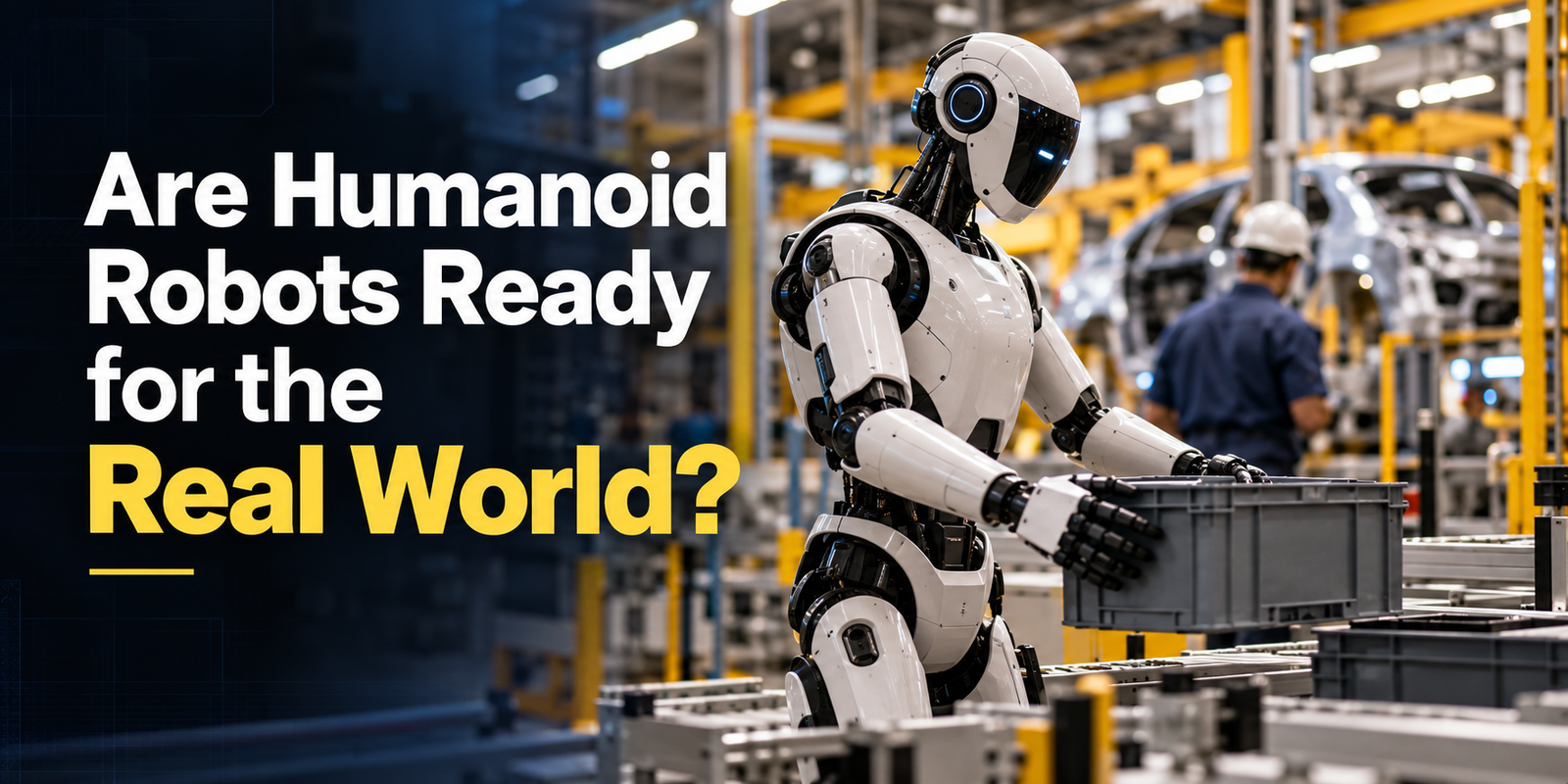

Humanoid robots have been very good at one thing – looking impressive in demonstrations.
They can walk, climb stairs, pick up objects and perform carefully planned movements. But a factory floor is not a product demo. Objects move. People get in the way. Tasks change. Machines fail.
Can humanoid robots work reliably enough to become part of the real workforce?
The answer is beginning to look like yes — but only for certain jobs, in certain environments, and with plenty of human oversight.
In 2026, we finally have enough real-world deployments to start asking those questions seriously. And the latest humanoid robotics news is showing that these machines are moving from controlled demonstrations into factories, warehouses and other commercial environments.
Humanoid Robots Are Already Doing Real Work
There is now enough real-world evidence to move the conversation beyond science fiction.
BMW’s experience with Figure 02 is one of the clearest examples. At BMW’s Spartanburg plant in the US, Figure 02 operated for around 1,250 hours over ten months, working ten-hour shifts, five days a week. BMW says the robot helped produce more than 30,000 BMW X3 vehicles and moved more than 90,000 components. Its job was specific: removing and positioning sheet-metal parts for welding. BMW Group
For anyone following humanoid robotics news, the shift is becoming clear: the industry is moving away from simply demonstrating what a robot can do and toward proving whether it can deliver reliable value in real working environments.
That is a very different proposition from a robot simply completing a demonstration.
Agility Robotics has reported similar commercial progress with its Digit humanoid. The company says Digit has accumulated more than 65,000 hours of industrial operation across customer sites, while one deployment at GXO reached more than 100,000 totes moved, with approximately 98% on-task accuracy. Agility Robotics
These numbers come from the companies themselves, so they should be treated as vendor-reported results rather than independent industry benchmarks.
Still, they show something important: humanoid robots are beginning to operate outside laboratories.
But Look Closely at What the Robots Are Actually Doing
This is where the humanoid robot story becomes more interesting.
The robots currently succeeding in commercial environments aren’t walking into factories and figuring out every task themselves.
They’re being given specific, repetitive and measurable jobs.
| What humanoid robots are increasingly good at | Where they still struggle |
|---|---|
| Repetitive movements | Unexpected situations |
| Moving standardised objects | Complex manipulation |
| Working in structured environments | Unstructured environments |
| Physically demanding tasks | Fine dexterity |
| Repeating trained actions | Adapting to completely new tasks |
| Working alongside existing automation | Making independent decisions |
BMW’s Figure 02 pilot is a good example. The robot was selected for a demanding but highly specific sheet-metal handling task. BMW also had to involve production IT, workplace safety, process management and logistics during the deployment. BMW Group PressClub
In other words, the robot didn’t simply arrive and start working.
The workplace had to be prepared for it.
That may be one of the biggest realities of humanoid robotics that gets lost in the excitement.
Why Build a Humanoid Robot at All?
Factories already have robotic arms, automated vehicles and specialised machines.
So why give a robot two legs, two arms and a human-like shape?
Because our world was designed for humans.
Shelves are built at human height.
Tools are designed for human hands.
Workstations are made for human movement.
Factories and warehouses are already organised around human workers.
A humanoid robot potentially has an advantage because it can enter these environments without requiring everything to be redesigned.
That is part of the larger Physical AI movement: giving AI a physical body that can perceive the environment, make decisions and act in it.
BMW’s new AEON pilot in Leipzig illustrates this approach. The company is testing the humanoid robot in battery-module assembly and component manufacturing, with the goal of understanding where a human-shaped machine can genuinely add value in existing production. BMW Group
The key phrase is “where it can add value.”
Not everywhere.
The Hardest Problem Isn’t Walking
A robot walking across a room looks impressive.
But walking isn’t necessarily what determines whether a humanoid robot is commercially useful.
The difficult part is what happens when the environment changes.
Imagine a warehouse worker picking up a box.
If the box is slightly out of place, the worker adjusts their hand.
If it is heavier than expected, they change their grip.
If another worker walks past, they move around them.
If the box is damaged, they know something is wrong.
Humans do all of this almost without thinking.
A robot needs sensors, software, control systems and AI to handle those variations.
This is why dexterity and adaptability remain major challenges.
A Reuters investigation into China’s humanoid robotics industry found that some robots still rely heavily on choreographed routines and struggle with dexterity and adaptability in real factory environments. In some cases, conventional robotic arms remain faster and more practical for specific industrial tasks. Reuters
That is an important reality check.
A humanoid robot doesn’t automatically become the best robot simply because it looks like a human.
The Business Case Matters More Than the Technology
This could ultimately decide whether humanoid robots become mainstream.
A company doesn’t buy a robot because it can walk.
It buys one because it can solve a business problem.
Suppose a specialised robotic arm can perform a task faster, cheaper and more reliably than a humanoid. There is little reason to replace it.
The humanoid becomes interesting when flexibility becomes valuable.
One robot could potentially handle several different tasks instead of requiring a different machine for every job.
That is the promise of the general-purpose humanoid.
Agility says it had more than $300 million in multi-year customer orders for its next-generation Digit 5 as of May 2026, subject to contractual milestones. Agility Robotics
But orders are not the same as mass deployment.
The industry is still moving through:
Prototype → Pilot → Commercial deployment → Scale
The final step is the hardest.
Safety Changes the Equation
There is another difference between humanoid robots and traditional industrial automation.
Humanoids are often designed to work around people.
That means a company has to think about more than productivity.
What happens if the robot falls?
What happens if someone suddenly walks into its path?
What happens if it misunderstands an object?
BMW’s own experience is revealing. Its Figure 02 deployment led to revised safety concepts, including additional barriers and partitions, along with improved 5G coverage in the production hall. BMW Group
The industry is also beginning to formalise the technology.
IEEE’s P3870 project, approved in September 2026, focuses specifically on reference frameworks, general requirements and safety assurance for intelligent control systems in humanoid robots used in production and services. IEEE Standards Association
That is a sign of a technology moving from experimentation toward an industry that needs standards, safety rules and repeatable deployment practices.
What Does This Mean for Jobs?
The popular question is:
“Will humanoid robots take people’s jobs?”
The more useful question may be:
Which parts of a job should a human stop doing?
The first tasks to move toward robots are likely to be those that are:
- repetitive
- physically demanding
- dangerous
- predictable
- difficult to staff consistently
That doesn’t necessarily mean an entire job disappears.
A warehouse employee could spend less time moving repetitive loads and more time handling exceptions.
A factory worker could spend less time performing physically exhausting movements and more time supervising quality.
That is likely to be the first phase of human-robot collaboration.
The larger employment question will come later, as robots become capable of handling more varied tasks.
So, Are Humanoid Robots Ready?
Here’s the simplest way to look at it:
| Environment | Readiness today |
|---|---|
| Structured manufacturing tasks | Increasingly ready |
| Warehousing and logistics | Commercial deployments underway |
| Repetitive physical work | Strong use case |
| Unstructured factory environments | Still developing |
| General-purpose office work | Not relevant |
| Homes | Still early |
| Fully autonomous general labour | Not ready |
The evidence points to a clear conclusion.
Humanoid robots are ready for the real world – just not all of it.
They are already demonstrating value in controlled industrial environments. But the jump from a robot that can repeat a trained task to one that can understand a changing environment and handle unexpected situations remains significant.